The "Teach English in Japan" Scam - The Complete series
- TeachEnglishInJapan
- Mar 5
- 87 min read

1 - Japan's Propaganda
Why am I doing this?
I've seen so many people not only dissapointed and deeply hurt by this system (including myself), but homeless and financially broke, that I'm fed up of it and have decided to start a movement, aimed at raising awareness of the harmful and deceptive practices of "Teach English in Japan" schemes, with a particular focus on ALT/Eikaiwa.
I'm fed up of people getting hurt, I'm fed up of people being dissapointed. I'm fed up with a lot of things related to what's going on here. so:
Creating this, will allow for the continual development and progression of this project. I'm not going to give you a wish washy answer with no real direction, or vague advice. I want to be totally clear, these buisnesses are evil, and anyone whose seriously considering joining one of these companies are completely mad. I'm here to tell you, this system rewards people who care the least about Japan. It rewards people who are bullies, manipulators and outright savages and that the only way to survive in these companies, is to become a bully, a savage and a manipulator yourself.
In this first series of posts, we will take a look at the pre-prepatory work of the "Teach English in Japan" system.
-
The Dream
What's the first thing you think about when you think about Japan?
Maybe it's that iconic picture of the Chureito Pagoda, with Mount Fuji in the Background.
Maybe it's beautiful ladies doing the Tea Ceremony and walking around in Kimono's everyday.
Maybe it's naked girls hanging around in an onsen. Maybe it's the Karaoke Bars, the sushi, the list goes on.
Maybe it's 'the Culture', 'the food', 'the people', 'no crime', 'the anime', 'the manga'.
Maybe it's those video games that feature Japanese Temples, Karate or some other aspect of Japanese Culture.
If you think Japan is just about the above, you have been the victim of Japan's Propaganda.
-
Japan's Propaganda Machine
What Japan is excellent at doing is creating Propaganda, designed to paint Japan as a place with no crime and all the things that you could possibly want in life.
In doing so, it has created the world's most sucessful Propaganda machine, designed to bring in tourists from around the globe. In everything it does, it paints itself as being a country of 'perfection'. Anything less than that is completely unacceptable.
The whole point of this system, is designed to instill a hatred towards a foriegners own country. "Why are we not doing it?", "Why doesn't our country do this".
What these foriegners do not realise, is that this is all part of the narrowminded propaganda machine, that aims to print a shiny, glossy image of Japan for foreigners, while hiding it's true nature in a place where it cannot be seen.
-
Japan's is only interested in money, which is why Japan hates foriegn workers.
People come to Japan and spend thousands of dollars, pounds, euros, into Japan's tourism industry and it is because of this, that Japan strongly distinguishes tourism as a strong point of revenue.
In fact Japan, would much rather rely on tourism as a source of income and growth, rather than provide any meaningful work to a foriegner.
If a foriegner ended up working in Japan, they would be earning less money (even though they pay taxes and pension contributions) and therefore would be contributing less money towards the state because they would not be earning as much, therefore it makes sense why tourism is strongly favoured over foriegn workers.
Even now, Japan is focused on increasing tourism and visitors, while doing nothing to support long term, foriegn residents.
-
The effect of the Propaganda Machine
The end result of all this propaganda, is that people have a mislead, image of Japan as the idylic, heavenly place to live. They have been brainwashed and manipulated by the propaganda.
They literally would do anything to have the chance to work in Japan and it is from that desperation, that the very seeds of the "TeachEnglishInJapan" Scam, has been sown.
Later on in the series, we will discuss how companies install their employees to have hatred towards Japanese culture and how most of the customers who use "Teach English in Japan" services, also hate their own country.
2 - The Job Application & Salary
Applying for a Job
Now that the foreigner has become so brainwashed into thinking that Japan is such an Idyllic country (as we read in part 1), that they must live there, the next stage of the 'scam' is fully inplace, since the applicant will accept any working conditions.
With little to no knowledge of the Japanese job market, they will apply using a host service like 'Gaijinpot' or 'JobsinJapan'. There, they will find a host of companies listing positions for 'English teaching'. They start to apply without noticing particular red flags surrounding their contract:
(Such is the number of red flags with these positions, that several subreddit posts will be dedicated to just the Job Application alone.)
1. Salary
Any decent job has a fixed salary, which may rise on the basis of time served in the company, but these jobs are different. Instead the applicant will see a ranged salary such as “220,000 – 280,000”. “260,000 – 300,000”.
In this case, this tactic is used to draw applicants in by the possibility of a high wage. The truth is, that every employee is performance assessed and therefore, only the very top band of instructors receive this level of wage.
In the case of NOVA and GABA, they don't even provide a monthly salary, instead it's based on a rate which is paid per lesson. That means your pay relies entirely on having enough high paying lessons, which themselves vary depending on your performance and how much profit the company makes from your lesson.
What you don't see on the job listing, is that any time that you are not teaching, you will be paid 880 yen, less than the minimum wage in Japan. This would be infact illegal in Japan, but many companies avoid having to pay minimum wage using various loopholes.
Both of these cases especially the second, are huge red flags of Black Company behaviour.
3 - Contracts and Location
Contracts / Full Time
Although it may not be explicitly stated, you are highly likely to placed on an annually renewed contract. This 12 month contract, will be the same each time unless you are promoted to a more senior position. With this, will come a 12 month Visa, since the Immigration Bureau will not offer any visa that extends beyond the length of the contract.
However, more and more companies are opting for 6 month contracts and even 3 months in some cases. Which places many applicants in the realms of the 3 month working Visa.
This makes no practical sense at all. If you're going to work in another country for 6 months or less, unless you have no money at all, I strongly suggest keeping your well paid job and go over as a tourist and applying for extended stay. There is no point at all, in quitting your current job to work for 3-6 months.
All the above should come as a red flag. You as the applicant, are paying thousands of dollars to work in a company, with no flight expenses paid, no expenses paid to travel to your countries Japanese Embassy, only to risk the possibility of being made redundant due to a non renewal of contract – which could be made under any variety of reasons.
What it amounts to when combined with the disgracefully low pay, is an extended paid holiday.
Japan's awkward social norms
Part of Japan's culture which is less favourably spoken about is proactive stereotyping. If you see a picture of a police officer, a nurse, a baker, a train driver, they are all depicted in a very specific way.
Foreigners are no different, so much is the difference between the physical looks of foreigners and Japanese, that many Japanese that see someone who doesn't look Japanese, even if they are a citizen of Japan, will get the so called 'stupid foreigner' treatment. This refers to: A) Even if the foreigner can speak fluent Japanese, they will be spoken over in English, B) You will be told how to do simple things like, how to wait in the queue, how to pray at a shrine... C) Given tape/stickers when making purchases encase you are stopped on suspicion of theft.
Nova/Gaba for example uphold this attitude by keeping foreigners separate from Japanese staff because according to the company: “they do not know each other's cultures and customs”.
Therefore, Japan would rather only use foreigners if they can find a ' specific use' for them. This is where the "Teach English in Japan” scheme fits in perfectly, because it is a role done that can be done by Foreigners.
“Foreigners speak English, so all foreigners should be... English Teachers!”. You are in all ways, a subject of objectification by the Japanese customers as a character and idol.
Location
On job postings, you will usually see “English Teacher required in Kansai” Urgently needed” "English teacher in Tokyo”. However these postings are deliberately misleading to gain interest and applications. These often come from companies that assign their instructors nationwide. It is quite possible for you to apply for (what you think is) a teaching position in Tokyo and then later find out that the company has schools all over the country and that in fact, you could be placed anywhere in Japan, even if it is thousands of kilometers away from Tokyo.
Applicants get no choice over where they are placed in Japan. Japan is a huge country at nearly 3,000km from tip to tip, it's deceptively bigger than it looks. This makes it highly likely that you will be placed somewhere undesirable, potentially up to 2,000km away from your desired location.
It is the tactic of ALT and Eikaiwa, to deliberately place the Instructor away from their desired location. This is done to increase pressure on the instructor to work hard and to achieve the requirements of the company. Once they have you placed somewhere you don't like, they will make it nearly impossible for you to transfer somewhere else, unless it is in the interests of the company.
Of course, usually there is never is a 'reason' for the company to move you, so you could be stuck in the same reigon of Japan, until you quit your job.
Some English Schools have no branches in main cities and so it's really important you research that first, before applying to a position.
Now your in Japan without that JR Pass, Travel becomes really expensive. It can cost 20,000 yen for two one way tickets on the Shinkansen, just to travel for an hour. If you get placed at the far reaches of Japan, it could cost you a day's travel and half a month's salary (up to 50,000 yen) to reach the main cities.
4 - The Interview
Before I start, I know that this one's going to be viewed a lot more than the other parts of this series, because a lot of you are only going to be interested in 'how can I get an English Teaching job in Japan' 'What are my chances of getting an English Teaching job in Japan' (naturally I'm laughing). But be warned, you must fully read everything I've written about the “Teach English in Japan” before you dive head first into this industry.
Today, it's about the interview process.
-
Overall process
Interview processes vary from company to company, some companies only interview once after screening. Most companies have 2 interviews, a general interview followed by a more specific interview, usually with the school you're going to teach at (that's right, you get no choice of where you are placed), or a more specialised employer. Sometimes, you will be interviewed in groups, sometimes as individuals.
AEON corporation currently have the most stringent of processes, requiring no less than 3 interviews, including a face to face in your own country, of which you recieve no remuneration for travelling to.
Some companies request references from previous employers, up to as many as 4 references. Other's don't.
Sometimes you will be asked to complete a questionnaire or complete certain tasks such as a written test, or grammar test. Some of these are extensive and can take up to an hour or more.
For one interview I was asked to 'stand up and introduce myself', usually this is done to assess the applicants voice and speech projection, although I have also heard that some interviewers do this to check whether your are wearing buisness trousers.
For another, I had to complete an online questionaire where I had to answer using my own, recorded spoken voice, some very probing and testing questions.
On the whole, interview processes vary widely but the end result is the same, companies are asking for more and more input during the application process to the point where it really just is completely exploitative and a waste of time applying. We're talking hours of filling in forms, finding documents, getting references, taking photographs, the list goes on...
The process is designed to weed out candidates who have a brain and know that the application process is stupidly over the top for a 220,000 yen job, and those who are desperate to come to Japan no matter what and it's that latter type that the company wants because they know they will be easy to exploit and do over.
Take AEON which is one of the worst of the lot, there is no way that a 3 stage interview process and even travelling for a face to face meeting, is even worth the money and conditions they offer. At least Nova in that respect has a good interview process in that it's quick and to the point and worth the time and money put in.
The actual interview
You will most likely be interviewed by another foreigner, usually an experienced senior with more than 10 years experience in the company. By this time, they've been promoted through the ranks of supervisor, manager, before being given permanent/secure work in Human Resources. Some interviewers are not even based in Japan but still work for the same company.
There are all kinds of questions that you could be asked in the interview, but the most common of these are:
Why Japan?
Why do you want to work in Japan?
What is it about Japan that you like? That you find attractice?
What attracted you to Japan?
How do you feel about being placed anywhere in Japan?
Would you be happy about the idea of being placed anywhere in Japan?
How would you deal with a disruptive kid?
Do you have (e.g. 350,000 yen) to fund a ticket, accommodation etc. (Unlike decent companies, you have to usually fund this all yourself - more in the next part of the series).
Would you feel comfortable meeting the business needs of the company (selling lessons and products) as well as the students? (usually applies to Eikaiwa)
There could also be some more specific questions such as:
How would you deal with being transferred to another school?
What would you do if you wanted to leave the school?
What would you do if a colleague started a conversation about politics?
You will most likely also be asked to demonstrate your teaching skills by doing a teaching demo for the interviewer. Sometimes you will be asked to prepare before the interview, but it can also take place without warning on the spot. A tactic used to see how well you can adapt to change, which is vital as an instructor.
Other things that you may be asked to do are:
Answer questions about the employer contract which you will have had to memorise before the interview. (common with interviews at AEON).
Complete a Japanese Speaking test. (likely for ALT interviews)
Demonstrate you're knowledge of what the company does, given that you have spent enough time memorising what the company's full range of activities are.
Because there are so many applicants to English Teaching, there is no secret formula to success in these interviews other than:
Being a likeable and attractive person who is likely to energise adults/kids.
Not showing any signs of rebel, or challenging the interviewer.
Not asking 'suspicious' questions about the company.
Some stroke of luck that you were the most qualified, experienced and likable applicant.
For some strange reason, HR feels that you have some obscure personality trait or some other quality, that might have a lot of potential for a particular use of theirs, even thought you were the least qualified and experienced applicant.
Companies will often reject applications where the the applicant has used the works 'order, discipline' in their CV or cover letter. The English schools really only care about you making English lessons fun, so that the 'customers' come back to spend more money.
You will also be told the ins and out of the job. Most likely you might be told 'this isn't a normal 9-5, Monday to Friday job', 'It's hard work, but very rewarding'.
Success rate:
Overall, there seems to be a success rate of 10% on any number of applications made to interview stage. Job offers are in the region of 2% or less. Only a few small fraction of those 2% make it to a permanent, stable position. I estimate that 0.002% of all people who apply to become English teachers will actually find English teaching to result in a decent position.
It is this extremely low success rate for the quality of pay, work conditions that you get, that makes English Teaching a really poor choice of career in Japan. This low success rate also demonstrates the company's commitment to provide short term, working holiday styled opportunities, rather than long term, secure work. (more about this in a future part). Ultimately they can do this because they know that the applicant is desperate for the golden apple (life in Japan).
5 - Visa and Travel
Japan's stance on immigration
In short, while Japan loves tourists coming into the country (because foreigners have a lot of money to spend in Japan to help boost it's ecomony), this is what they want the world to hear. The real truth is that Japan on the whole, Hates the idea of foreigners living in their country to take up residence. The Japanese government and companies have done little to almost nothing to expand opportunities for foreign workers, except for work that no Japanese national wants to do.
Japan relies on cheap foreign labour disguised as 'training'. Indeed, the Specified Skills Visa that was recently (in historic terms) introduced into Japan, allows companies to bring in immigrants to work in Japan for a specific amount of time, under the guise of training. This is limited to countries like India, Philippines and any country where the people are used to working really hard.
However, this is a round about way of exploiting foreign workers, providing minimal protections and rights, while maximising the productivity and cost savings of the Japanese company.
Such programmes are almost entirely limited to a set amount of time, usually with a cap of 3 years, but this has been decreasing in recent years.
-
How this applies to English Teaching
As an “English Teacher”, you will be likely assigned the 'Humanities, Engineer, International services visa, which isn't a bad visa, it isn't a great one either. 'English Teacher' counts as a foreigner language service.
What is more limiting however is your contract that your company will offer you. Usually it's 12 months, but in recent times, this has been reducing to 6 months and on one occasion, I've seen a post on “teachinginjapan”, referring to a position offering a 3 month contract, which brings about the possibility of the 3 month work visa.
Such contracts are essentially “Working Holiday” styled work, for which a Working holiday visa would suit just fine, with the exception that there are certain limitations of that Visa, that does not work in the favour of the company. For example, if they do find someone who they like and want to keep on, then it would be impossible to renew the Working Holiday Visa, so many times, compared to a Working Visa.
It is quite possible, that as an 'English Instructor”, you will face constant, yearly contract and visa renewal screening, at any point of which, you could be turned down and lose your position in Japan. Get ready to prepare to fight, year after year after year, to keep your position and to compete against all the other English Teachers, in a survival of the fittest. (More in a future post)
-
Your visa process
-
There is nothing I can tell you about this process due to the rules of reddit, if you are offered a position in an English School, they will do what they need to do to help you with the process.
What I can tell you is; You will not receive any reimbursement for applying for the visa, you won't get paid for your travel expenses to the Japanese Embassy in your country, or the time taken to do so.
You must get all the right paperwork and documents ready for when you enter. There are no exceptions. Nobody beats the immigration system.
-
Travel
You won't receive any flight reimbursement from the company you apply to, which is precisely why they ask you whether or not you have a lot of money. It's an utter disgrace that a company should ask you whether or not you have the money in the first place and if they do ask, it's a clear indication of the “Teach English in Japan” scam.
Companies do this because if you buy your own ticket, it feels more personal and closer to your heart, you feel as if you're in control and it reinforces this deception of 'a life in Japan', now that you're working for a black company. The truth is, the company you're working for, cares so little about you, that they're quite happy for you to suffer financial loss and to deflect any sense of responsibility onto you. Some English Schools do offer flight reimbursement after completing the first contract. However many English Schools don't.
But...
Any professional English Teaching position will do the exact, opposite and pay for your flight simply because it's professional conduct. It depersonalises the travel and should you fail the contract, you just pay the company back the money for the airfare. The only reason you are in Japan, is to work for their company, so the expense should be on them.
But it isn't because this is one of the many tactics that these scummy companies use to manipulate and exploit thousands of foreigners every year, while a very, very few do succeed, living the real goal of 'life in Japan', that so many thousands believe that they could get.
In the next part, we will start to really dive deep into the details of what it's like to work in an English Teaching scheme.
6 - Training
Now we can finally get into the details of the job itself!
After you completed all of your visa application, travel and accommodation arrangements, you will be asked for details about your flight and where you are staying.
During training, you will have to stay in a separate location away from your actual assigned location. It's usually located in a big city. In the case of Nova for example, it always takes place in Osaka and Tokyo. If you are assigned west of Osaka, you'll be trained in Osaka, otherwise you'll be trained in Tokyo, if you are assigned around that region and north.
Some companies offer to pick you up directly from the airport, direct to their temporary training accommodation. They say, that this is to provide support and help to the foreigner as much as possible, while in fact, this is to take as much control over the movements and activity of the worker as possible, by literally taking them directly from the airport to the training location, it gives no space or opportunity for the foreign to enter the country and do something else that the company doesn't want them to do, for example, arrive earlier than desired and to use that time to explore around.
Most Teach English in Japan schemes expect you to pay for your own accommodation during training, even if it belongs to the company and will subtract this from your first paycheck.
-
The training itself
You will be told to attend in business clothing, which as will be later covered in more detail in a future post. This a coercive tool designed to control the behaviour of the instructors and to create a false impression that the work they are undertaking is a true professional role. I still remember the time before taking up the job, where I had spent hundreds of dollars on business shoes, coats, shirts, ties, jackets and even a business satchel, all to no expense of the company, while elsewhere, you could work for a large grocery store and get free uniform.
It is in this spirit, that many English Teaching schemes aim to assimilate a professional environment by imposing all sorts of rules onto the instructors which you might expect in a real teaching job. All of this is done to cover up the fact that you are actually working in retail and sales work, disguised as English Teaching.
-
'The System'
Training itself focuses almost entirely on teaching you 'the system'. It is especially true that Eikaiwa employ their own 'system. This system features numerous textbooks (products), that the company aims to sell to it's student's (customers), for which your job as the instructor is simply to regurgitate the material on the page.
The books themselves are next to totally useless, other than to provide a basis for the teacher. In other words, the books really don't have any use on their own. They usually feature a little picture, some words and phrases, a vocabulary list and a very few exercises, all of which you're told to pad out and to make it last the length of the lesson. It would be the equivalent of providing a recipe book with just the raw ingredients on the page. It's your job as the instructor to 'teach' the 'student' how to make the recipe. The idea is to give the impression that the instructor is teaching and providing a lesson, whereas all the instructor is actually doing, is acting as some kind of live audio narration and providing the odd bit of advice, based on their Native speaking language.
A few times is tolerable, but throughout the 1-2 weeks of training that lasts 8 hours a day that you will receive, you will be drilled over and over, how to give an Eikaiwa lesson, I.e how to take the content on the printed page and turn it into a lesson, practising over and over again until you go out into the job itself, to do this around 1,800 times per year, spending up to 9 hours a day, 30 hours per week, regurgitating material from a textbook, for as many years as you can tolerate feeling like the most bored, worthless, unskilled, brain-dead and exploited person in society, with the hope that one day, you might find a better job or get promoted where you do less and less until you reach mid level management, where you no longer have to be out in the field.
You are told that there is hardly any planning required, because the lesson is already planned, it is literally the content printed on the page that you have selected from the book for the student.
Kid's lesson's which make the most money for the Eikaiwa, you are given in the case of Nova, just two days training to deal with Children from the ages of 3 years up to high school. If it sounds completely ridiculous and unbelievable, that's because it is. Even at the time of my training, another trainee challenged the management, saying how people spend years and years training to teach children professionally. The management deflected it by saying that you'll just get the hang of it in time.
These training sessions are usually given by senior managers of the company, these could include, area managers, general managers, national managers, anyone who has enough experience to really sell the impression that they are experts, however we will later cover in a future post, how most of the information they have, is fake, made up information and designed to make them sound like expert English Teachers.
There will also be a Team Leader, or supervisor present, sometimes another manager, that will help make the students feel at home. Usually the team leader is a highly energetic, bubbly and outgoing person, which is often why North American women, are often promoted to this role, in some cases as little as one year.
What is actually happening during training, is that you are being subjected to brainwashing and conditioning, designed to lock you into being able to produce, very, very consistent lessons that all share the same characteristics i.e. Saying 'Good job' really enthusiastically every time the student get's a correct answer. Using extremely precise and prescribed language such as 'Let's have a look at...' 'let's...' and making sure to follow the laid out structure of the book exactly to the letter. All the time, the managers drill the precise language into you until you use it correctly. Even among the Japanese, the phrase 'Good Job', has earned itself a kind of cult status.
Training videos are often used, featuring an idyllic lesson that every instructor should inspire to give which will almost never happen. As will be discussed in a later post, even if you do provide a perfect lesson, you can still be defeated by the system.
-
The People being trained
Looking back on it now, I should have been very concerned to see about 40 people other being trained at any given training session. How come I thought that being an English Instructor was a prized job? How as it that so many applying were getting rejected and yet here was a room full of trainees?
Nova for example, runs 2 training dates per month. Up to 1,200 instructors could be flushed through the company every year.
Most of the people who where at the training were in their 22's- 30's. Many of which were unbearably immature, negligent, arrogant and also had the bug about Japan. Some had connections to Japan already, either through their girlfriend or wife and wanted to find work in Japan, other's came in with no connections at all. Some are there because they are qualified TEFL's, going from country to country, teaching English. Some are there to exploit the visa and than hop onto another job.
Be cautious therefore of who the company chose to employ, take notice of their morals, their way of thinking because they all share something in common...
They've all been tricked into thinking that becoming an English Instructor is an opportunity that leads onto something else, without realising that the number of people who actually end up achieving that goal, is almost non existent and that they've already fallen into the 'Teach English in Japan' trap.
Before they realise it though, they are for a time, the happiest people on the planet. They've landed their dream job, living in Japan. They are literally the king's of their own world with nothing but a 12 month contract and visa hanging over them, as well as what one manager said 'a job that's harder than anything you've ever done before'. Not because it is, but because it's designed to make people fail.
At the end of training, it's unlikely that you will ever see any of the other trainees again, since you are all given locations far and wide all across Japan and the costs of travelling to far locations can cost half of your monthly remaining pay after tax and insurance.
-
Training in summary
In summary, training is not so much about training as it is to indoctrinate you into the system that the company has created, a system that works because it requires minimum effort on part of the employees and creates the illusion of the instructors being highly skilled, professional teachers. It would be quite possible, for any given stranger of the street, who speaks English to pick up one of the books created by these Eikaiwa, and to be able to give a perfectly acceptable service.
So what do you learn during training week? Nothing. It serves no other purpose than to brainwash and condition you, to reduce you to the point of complete and utter servitude with not a slice of forgiveness and tolerance for failure or mistake.
The training is just crappy, crap, crap, crap. You don't learn even half of what you need to know to be fully prepared and most of what you learn is after training, other than providing the absolute most basic of basics. Then so many months later, the bosses complain when you can't recall something that apparently, you should have learnt in training, well that's because we never did learn about it. Instead, we learnt about how much the National Level manager likes his wife and 4 kids, in his house and how he likes to shop for foreign foods. My gosh. I can't believe how empty my head feels...
As we go on throughout the series, we will explore more and more, how the Eikawai particularly, is more interested in business than having any real connections about teaching. We will see how the high ups in the organisation have no interest whatsoever in the students and expect the instructors to falsify and deceive their customers that there is a genuine interest taken in the student, but in reality, it is not being done for the customer's interest, but for pure profit. We will see how being a successful 'instructor' in this business, is about your skill to uphold, paste and to decorate this manipulation as genuine care and interest for the customer, who you have to treat as genuine students, while those high up in the company, demonstrate their knowledge that the reality, is a very different story.
7 - Accommodation, Costs, Location, Probation, Personal life,
Training is completed, you have some last moments with your trainees that you've befriended before being slung out all across Japan, never to see them again, likely. For some teachers, they won't have had to book a hotel for thier training since their location is either in Osaka or Tokyo, close to the training centres. For other teachers, they may have to travel so far, that they need to fly again to get to their destination. You won't get any reimbursement if you had to pay for a hotel.
Some schools give you no choice but to use their own apartment, which gives them an enormous amount of control and leverage over your life, your address (which is legally vital for the validity of your visa) and whether or not you can actually live in the apartment when you decide to change jobs.
You can find your own apartment, but then there is the complication of dealing with Japanese paperwork, Japanese landlord's who don't want to take the responsibility for offering housing to an illegal foreigner who won't respect the apartment because they "don't understand Japanese culture". The solution is that almost all Landlords in Japan, will simply not offer you an apartment. You will most defintely have a hard time proving that you're working, for a genuine company and that you have the legal means to live and work in Japan (Landlords can be severely punished for helping to house an Illegal migrant).
If you are offered one, Leases could be as long as several years, locking you into the the need to perform well at the given English School, with the guarantee that you won't be transferred. If you end up loosing your position, you may have to pay hundreds of thousands of yen in charges and fees for ceasing your tenancy contract.
-
Location
Given the case of Eikaiwa, The location of your school really makes a huge difference to the types of lessons that you will teach. If you are given a city placement, a majority of your students will be adults. That completely reverses in the countryside, where most of your lessons will be with kids.
All Instructors who work at English Schools are subject to the possibility of transfer, as part of the legally binding contract. This is often so rigid, that the only way to leave a certain reigon at your own choosing is to resign. Some schools do not even provide a choice at all and you are just expected to fulfil the needs of the school entirely, regardless of any other factors outside your work.
At any stage, you could be transferred involuntarily, which could harm the relationships that you make with other Japanese people around you. That also includes the relationships made with students and customers.
If you live alone, the company will be particularly 'flexible' with you, when finding places for you to be moved to. If you are living with a dependent or significant over, your chances of being transferred are reduced.
You can in some circumstances, request a transfer, but that usually requires you to reach a certain level of performance at your school.
At every opportunity, the English teaching role is designed to keep you locked down within your designated reigon, in complete servitude to the interests and needs of the company, with no consideration for personal life outside the workplace.
-
Personal Life and work
Japan has traditionally been a country where work comes after relationships and family. For this reason, it is not uncommon for families, husband and wife to live separately. Actually, it is a luxury in Japan, to even live with your significant other, despite it being a requirement for a spousal visa. Company bosses on the other hand, not only live with their partner, but even work with them, especially in a family business, but then you on a work Visa, don't have that luxury.
This tradition is rammed down your throat as an English instructor, as pretty much all English Teaching Programmes, do not give a slightest toss about your private life, what's going on outside, or anything. Actually, your private life can be weaponised against you and if the English School finds stuff out about you, you can quickly find seniors manipulating you and using your personal life, to blackmail into working harder for the company or else... "Well you know, We will have to change your shift, so you wouldn't be able to go on that holiday you've planned with your partner right?"
-
Costs
Apartment costs run very high, especially if they are owned by the school. They can range from 40,000 yen to 80,000 yen in big cities. That will leave you in some instances, less than 100,000 yen spending money, that's about $600-$800 at the very most.
Utility in Japan is cheap, water bills can often be below 1000 yen every few weeks and electricity bills can cost 2,000 yen. Compare that to the US where those bills could be up to 10 times more expensive, perhaps even more. Municipal tax is expensive however, around 150,000 yen or more, which is a good few months paycheck. In your second year in Japan, you have to pay further taxes and insurances, thus reducing your already exploitative pay even further.
-
Probation
It's not just English teaching, but most jobs in this age come with a 3 month probation. In addition to this, there is a 6 month period where you cannot take paid holidays or any time off. You will be expected to attend 100% of your assigned shifts. You won't get told when the end of the probation is, even though you can be fired, for not meeting the expectations of the school. There are some stories on Reddit suggesting that instructors have even been fired during training itself. Imagine spending thousands of dollars on your flight and Visa, then being fired before you've even started the job.
During this probation, you will be offered 'continuing support' from your supervisor, to 'support your transition into the school'. Sounds great doesn't it? Well the support you receive is somewhat, absolutely useless, other than providing the absolute minimum required to technically give a lesson. What you do get, is a micromanaging critic, who will pick you up over the tiniest little detail.
It's difficult to talk about this without talking about my own experience so I'll do just that.
At Nova, for 2-3 months, I was under the supervisor working with them to improve my 'teaching'. The support that I got to start with was fine, but within weeks it quickly diminished to me on my own, running the lessons by myself.
The training material availible was: Online training videos with cherrypicked example students, lessons outlines and plans, descriptions of activities and games, a so called 'presentation guideline' (How to introduce new words to kids). A long 'NBK guide', that went into detail about how to work with kids, but in no way even comes close to the experience that a professionally qualified teacher would have.
Looking back, there is no way that anyone without years of experience with children could possibly expect to deal with a classroom full of kids on their own and expect to deliver first class service, worth the money that the parents pay for their kids to attend these lessons, to pay for their textbooks which they must renew twice a year. Of course, these are wealthy parents mostly, so it's nothing to them really.
-
The overall approach is the same as what a spider does to it's babies, it gives birth to them, they spend a little while together and then they get flung out of the nest, they either survive and do well, or die.
These English teaching schools are nothing but animalistic at the very least in that they follow that exact expectation. You either do well as an instructor, get to stay, get your dream life in Japan, or you don't do well and end up loosing it all and the Eikaiwa could not care any less about it.
It's a roll of the dice, whether you get good students, good supervisors, whether you're liked by the students you teach. I've often described these English teaching schools as Multi-Level Marketing schemes, disguised as English Teaching. As the series will continue, we will dive more into that and begin to see why, not only are these companies predatory, but when you come out of the other end and all fails, you really end up effectively 'scammed'.
8 - Pay is a 'pay'ne
Pay
The pay you get will vary from School to school, but poor quality work offers the same wages, 200,000-270,000 yen at most. About 1000-2000 yen per lesson, but more likely, you will earn the lesser average of the two.
Some schools such as Nova for example offer terrible salary conditions with an extremely complex and confusing pay systems. Systems like this are deliberately designed to whitewash their pay, both to cover up the fact that they pay less than minimum wage and how much money they actually make from the scheme (something I'll cover in a later post).
-
-
-
The following is taken directly from Nova's employment contract and describes how your pay is calculated:
Basic Pay: 830 yen ((50 minutes) including nighttimes 22:00 – 20:50)
Assignment allowance: 200 yen (50% of that is paid as 'nightshift allowance')
This is complete nonsense, no-one in my experience works night shifts as an instructor and the latest possible lessons finish at 21:10, so this night shift allowance is never paid.
Lesson Cancellation: 600 yen is paid as a 'standby rate' until the student arrives at the lesson.
General Duties: 800 yen, (I.e vacuuming the floor, folding paper, cutting paper, wiping the windows in the school etc.) In your suit an tie of course.
Regularity allowance: 100-150 yen on top of base pay for each lesson based on your lateness or absences:
0-1 150 yen.
2+ 100 yen.
Overtime: 125% of the lesson for more than 40 hours a week (doesn't happen unless you get extra work)
Lessons between 22:50 and 05:00: Assignment and skill allowance paid at 125% (again, this is complete nonsense because schools are closed at this time)
Transport allowance: 100 yen for each lesson paid, though sometimes, actual travel costs or travel pass will be paid instead.
Retirement allowance and bonuses: Not paid
other allowances: paid at employers descretion.
Skill allowances: 0 – 800 yen based on your Key Performance Indicator. (Skill allowance is 0 yen per lesson(talk about taking the jeeze)
-
All the above only deals with basic pay and a whole range of other factors that could affect the pay you get. But that's not even dealing with the actual pay differences depending on the type of lesson:
-
During probation, for 3 months you receive no additional payment based on the lessons you teach. After that:
Adult lessons:
1-2 students: 150 yen
3 students: 300 yen
4 students: 400 yen
five to 8 students: 500 yen
Man to man (private lessons including KIDS) : 200 yen
KIDS:
(face to face)
1-4 students: 200 yen
5 students: 500 yen
6 students: 600 yen
7 students: 700 yen
8 students: 800 yen
online 5-9 students: 300 yen
Other
VOICE: 200
NOVA Score: 100
KIDS Level up: 200
Live Station: 200
-
In all of the above, there is no promise of guaranteed minimum wage, which is actually below minimum wage. Because the lessons are 50 minutes each (10 minutes preparation and the actual lessons being 40 minutes), you actually end up being cheated of 5 hours of work per week, which is excused as break time, where you are not paid to be at work.
Good jobs pay according to experience and age, not by such a huge range of factors such as this. Anyone who finds something like this in their contract should quite literally be prepared to walk out of their job.
-
-
-
Pay in Summary
So what's the catch?
The trick is, you won't necessarily read the details of your pay conditions, until you are in Japan at the training centre. This tactic of waiting until the last minute to reveal what you are actually being paid for, is again, another tactic used to force you into poor quality work. You've done the harrowing interview process, got the offer, done the visa, got your accommodation sorted, took a 14 hour flight to Japan. Only then at the training centre, are you provided the actual details of your pay.
Most people will apply under the impression that they will receive regular pay. They won't. Instead they will be subjected to an incredibly complex pay system, which makes it nearly impossible for any teacher to keep track of their earnings and at best, awards disgraceful compensation, in comparison to the money that the English school takes back.
What really gets the blood boiling for anyone in this situation, is that if they had some other right to be in Japan other than work for an exploitative system, they would actually earn a decent amount of money. Schools such as Nova do have the advantage of being widely recognised, but even so, even working as a private tutor, if you worked really hard, you could easily earn multiples of the amount of compensation you receive. But, because the immigration services will not allow for freelancers, least you have a spouse or some other right to work, these instructors have no choice but to work at these bloodsucking companies that drain all of your potential earnings and filter them up the hierarchy.
Companies will also ensure to include a clause in their contract that forbids you from working as a teacher outside of their school and even working as an English Teacher, for up to one year after your employment has ended, meaning most people stand no chance of making decent money as an independent English Teacher because of their Visa restrictions.
Furthermore, in the full version of the contract which is actually provided on Nova's Online Instructor system, there is a clause that forfeits all of your rights of personality and identity, and gives it to the employer. They literally own the copyright to your identity, your image and persona.
All of this is designed to be used against you, should you cause any problems for the school and is a clear indication, that these companies literally use every opportunity, to exploit your vulnerable position as a foreigner and to use it to cause as much trouble as possible, should you resist.
9 - Key Performance Indicators





2025/04/08: Small clarification about KPI's
Here is yet another something, that the 'Teach English in Japan' schemes don't want you to know, until you're deep into your training. In my case, it wasn't until the 3rd day of training, that the manager suddenly revealed to us out of the blue, that actually, instructors get KPI's. I knew from that moment, that I was totally screwed up and that there was no way, that this job was designed for long term job security.
-
Key Performance Indicators KPI
There is no worse nightmare in any job than to be treated by your company, based on your performance. This vastly western based system does not in anyway, reflect or respect the traditional working practices of Japan, which is respect based on hard and dedicated work, regardless of the results.
Key Performance Indicators are systems used to judge how well an employee has done their job. It's mostly used in the sales industry as well as packagers in fulfillment centers. KPI's creates job instability by basically stipulating that "If you perform well, you will get treated well and might get a promotion, if you don't you will be treated poorly and eventually demoted". In the case of NOVA, KPI's have a dramatic effect on the way you get treated by the company as follows:
Most scummy schools use KPI's to make key decisions such as your pay, whether you get preferential treatment such as shift and transfer requests and ultimately, whether or not you get your contract renewed. Often, you will be compared to other teachers within your school and area, so if you are placed in a location where there are lots of high scoring teachers, you could face a lot of problems if you get low scores.
Like in many of my posts, I will be using Nova as an example, since this is my primary 'experience', but a lot of what I've said also applied to any schools that make KPI checks on their staff, which include most poor quality positions. In general, if you see a pay score such as 210,000 – 270,000 yen, you ca be assured that the job is based on KPI.
-
The KPI system
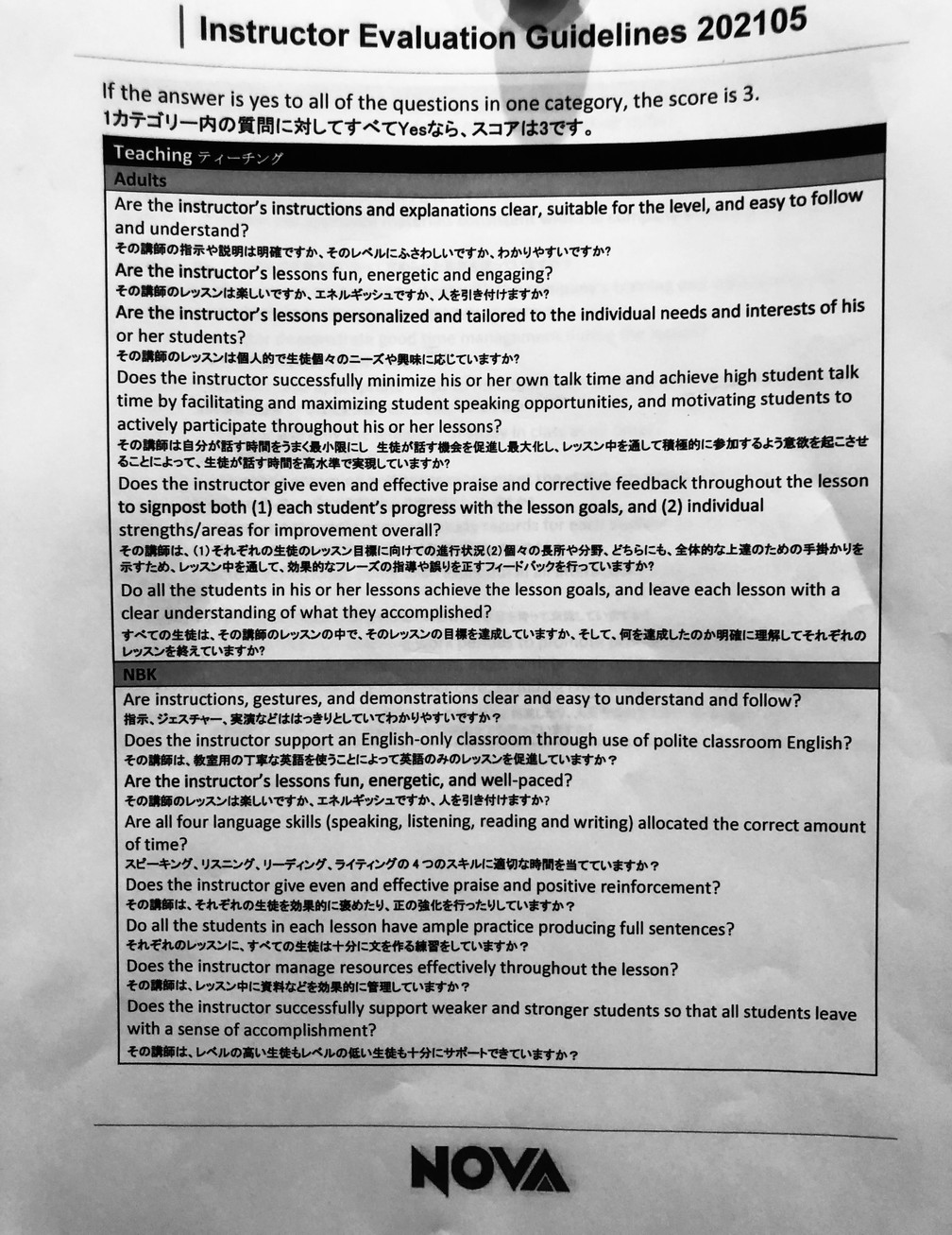
In order to meet the minimum expectations at Nova, the instructor must satisfy every single one of the 37 criteria set out in the “Instructor Evaluation Guidelines”. There are 4 categories “Teaching, Diligence, Customer Service, Contribution”. Instructors are scored from 1-5 based on the instructors performance. In order to get 3,3,3,3, the instructor must satisfy every one of the 37 conditions.
Scoring a 4 makes you a really good teacher, while 5 is extremely rare and reserved for only the most outstanding instructors nationwide. I have inside knowledge that 5's used to be dished out regularly.
If you fail even just 1 condition, you score a 2 for that whole category and are deemed unsatisfactory. A score of 1, gets you reported to the Instructor manager, the big boss. An undesirable instructor gets less pay, less favourable working shifts (such as split day's off with a working day in between) and a greater likelihood of involuntary transfer.
It is the general practice of supervisors to mark down your performance as much as possible, which effects your skill allowance. They also do this to save the company money, because a high score means the company has to pay you more money.
And remember all of this, if for less than a Uniqlo store clerk gets paid. Even if you were the most excellent, legendary, superhero instructor in Japan, scoring 5's across the board, you would get paid 800 yen extra per lesson, which amounts to an additional 126,000 yen, but I've never seen a current case of this happening. The amount of extra work, that you would have to put in, in order to achieve those kinds of scores is not worth it.
As a reminder, Japan's history of work ethics, traditionally has never been based on performance. Performance is an American based system that was founded in the 1970's by Intel. Since then, it has been introduced worldwide across many large scale corporations, particularly sales, and, into English Teaching schools by foreign managers (usually north American), as a way of firing and promoting instructors who they either don't like or for one reason or another, doesn't meet the expectations of the company, or on the other hand, promoting the best instructors. Once an instructor has been promoted to Supervisor, they never get evaluated again and in fact, evaluate everyone else's performance. We keep saying 'expectations' but what exactly are they?
-
Customer KPI
If you thought being subjected to KPI was bad, what about if there were 2 KPI systems?
That's right, at Nova, your performance is also based on customer review. You will give up to 156 lessons per month, but every customer can review every lesson and is strongly encouraged to do so. Scores used to range from 1-10, but now they range from 1-5. Only the very best instructors get perfects scores.
Some instructors compete to be in the top instructor list for the month. Doing this get's you a 100,000 yen bonus.
Customers can also use the system however, to give you poor reviews and scores and when you do, you'll get roasted by your supervisor.
-
Summary of KPI
Key Performance Indicators having nothing to do with Japanese societal values, including those related to work. They are something that have been introduced to Japan by America, perhaps other western enterprises, of which some Japanese companies have launched into it, as a way to monitor and control their employees.
KPI is another key factor in the lack of Job security. You are categorically being told “you better perform and get the scores, otherwise you're out, and, we're watching you at all times”.
In all that we are seeing, the constant lack of Job security is a key feature of 'Teach English in Japan'. It reflects the whole ethos of poor quality work in Japan; 'get people to come over, train them at the double on the cheap, then send them home'. Truth is, these jobs have no value whatsoever, they damage your CV and career and do nothing to contribute to your growth as a person and instead, lock you right in so tightly, that it'll hurt to get out.
You are nothing more than human stock, herded cattle ready for the slaughter.
10 - Chef Excellence and Professional expectations
Uniform
You will be told to dress in business clothing. This serves two purposes,
The first is part of a range of coercive tools designed to control the behaviour of the instructors. We already spoke about in training, how most of the new instructors are immature and have a certain arrogance, which the Eikaiwa HR's love because as an English instructor, you are required most of the time to speak English and to project your own culture onto the students. The buisness is very rough and tumble so you need a certain hardness for that. Dressing instructors in business clothing is to indoctrinate a sense of 'this is serious, professional work', into the new instructors and it also plays into the second purpose:
Creating the impression that the work they are undertaking is a true professional role and making the students (customers) believe that the instructors are truly professionals, is part of the Eikaiwa thing. You may have come across the YouTuber Ashens, who did a serious of stay fresh plastic bags, featuring the mascot 'Chef Excellence'. Someone who was likely paid to put on a white top, a chef's hat and gurn a bit, to give the impression of being a true professional chef. Companies like Nova, AEON and practically most other poor quality jobs, employ that exact tactic.
The point I'm trying to make here is Anyone who comes from an English speaking country, could put on a suit, a tie, a name tag, and after that, will fit right into that preformed role. Preformed, because remember, the training is designed to indoctrinate the trainees to fit exactly into this role model. The exact language, ques, pick up lines and prompts are pummeled and pummeled until the managers get exactly the response they want and it's written word for word, in swathes of lesson, activity and presentation guidelines. Those than don't simply get 'discharged' (the contractual term for fired/sacked).
These jobs require no skill whatsoever other than your native language which from your point of view, isn't a skill. So any old mad hatter could get a teaching job, as long as they have a degree because the companies that run these schemes, don't care. They don't care about you, they don't care about your past, they don't care what job you did last, they care about nothing, to some extend, they don't even care about the students who are often called 'customers' by management. The only thing that they care about, is that you can serve their need for generating more and more profit.
I realise now just how much of a false front it all is and how much I was manipulated into really believing that I was doing a fully professional teaching job. Prior to starting my role at the Eikaiwa, I still remember the time before taking up the job, where I had spent hundreds of dollars on business shoes, a $200 coat, shirts, ties, jackets and even a business satchel, all to no expense of the company while freely providing them with what they expect. Elsewhere, you could work for a large grocery store and get free uniform, though aprons tend to be more popular in Japan because they are less expensive.
How stupid I must have looked, to dance and prance around in a suit and tie singing "Hello, Hello...", while the kids stood their and thought, Who the heck is this pratt?
How stupid I must have looked when I was wiping windows and sticking a vacuum hose into dust filled air conditioners with my suit and tie, for less than 830 yen every 50 minutes.
All of this, because countless people are so utterly desperate to live in Japan, that they must live in Japan, whatever the cost.
-
You're not professional but be professional
It is in this spirit, that many English Teaching schemes aim to assimilate a professional environment by imposing all sorts of rules onto the instructors which you might expect in a real teaching job, yet in reality, there is no compensation whatsoever for your sacrifice. All of this is done to cover up the fact that you are actually working in retail and sales work, disguised as English Teaching. At all times, you are expected to behave and conduct yourself in a 'professional' manner. Such expectations are widely known, but just in short:
You are expected to behave professional like a real teacher at all times. That's because if you didn't, it would give away the fact that you are not really a professional teacher and that would harm the false image that the Eikaiwa has worked so hard to project. The Eikaiwa will not tolerate it.
Contact with outside students is forbidden. Ths is understandable if the students involved are children, but this also extends to all adults too. There are some understandable reasons for this. Japan can be an extremely dangerous place to be, if you are not familiar with all the rules, not just law, but cultural and social rules. At Nova, a teacher was murdered by a student many years back when they went to a student's apartment. There are lots of cultural differences and if there is say, romance involved, it could get really ugly really quickly with a lack of understanding. Another part of that is that the Eikaiwa, simply doesn't want you to take business away from their school.
You are also expected to uphold the Japanese expectation for perfectionism. Anything less will result in a word from your boss and punitive action if you do it again.
There are numerous other rules but most of them follow what you would expect in a real teaching profession.
There is no tolerance AT ALL, for anyone who doesn't meet or respect these expectations. It simply is a one way power trip, from supervisor, to assistant manager to manger, you will be made to feel the power of the big bosses, and any decent will result in merciless punitive action and I can tell you from experience, the managers really do totally power trip you all the time. more in a later post.
There is no support offered by the system at all. If you get involved in mental or physical health issues, you are 'discharged' with near immediate effect.
-
This is the number one catch with English Teaching. Because it is treated as a professional role despite being paid less than Uniqlo store clerks, if you falter, there's no safety net. You will fall all the way to being forced to leave Japan.
It is utterly disgusting and a disgrace that people who travel far and wide, spending thousands of dollars, investing their hearts and souls into Japan, get no support whatsoever should they enter into a difficult situation and instead, are just fired. It is the most dispicable exploitation you could possibly imagine.
However again, Japan has very little in the way of mental health support which you have to pay for yourself. There is support line available but often, the health service will dial a translator to help out, so you're not really going to get that support unless you live in the big cities.
I tried using the support line myself when things were getting tough but it seems as is the service 'isn't available' at most times. You ring and the line is dead most of the time... I think that says everything you need to know about the state of mental and physical health in Japan.
11 – Management and KPI Implementation
Hierarchy
Make sure to look at the Hierachy picture uploaded the seperate post.
There is no clear indication of exactly what the hierarchy is at any given company, such information is given on a need to know basis. It is deliberately confusing as to conceal the MLM structure of the company. In my case I worked at NOVA.
At the bottom of the company are the Store staff and Instructors, both are on equal footing, definitely not equal pay. They have Instructor Suport Managers and Area Managers supporting them, though in some locations, foreign staff also seem to be area managers.
Above them is the assistant Regional and Instructor Managers. They are responsible for the most of the day to day dealing of Instructor schedules, pay and other business.
Then there is the Regional Manager called formally the Instructor Manager who are the ultimate authority in relation to the instructor. They decide the contractual terms, whether or not the instructor stays or goes and all of the most important decisions within their region. There are also 'General Managers', whether or not these are related to the Instructor Managers is very unclear.
Although it was never said to me, it is clear from an inside source, that the regional managers are not in fact at the top of the chain and that there is a national level of management, which seems to be disguised as the 'instructor training and recruitment division', or HR. This is where the most senior of staff are based. Staff who have positions here have been at the company for more than 10 years, some 15, some even more. This is spearheaded by a National Manager, who appears to be the ultimate boss on the foreign staff. There is likely a Japanese equivalent but I have no supporting information about such a position existing.
Any company would have a technical department for IT, which there appears to be, but it's completely unclear as to how it operates. There appears to be Indian staff working there, whether they are in offices or based in India, serving Nova remotely, I don't know, but it's very hush, hush. Likely to prevent Instructors from asking whether there are any IT positions in the company.
At the top of the whole system is the President of Nova, who also heads all of Nova's educational activities, Gaba, NBK and likely other areas. That President also has a boss, who operates the entirety of NOVA holdings. It is known that that President of NOVA holdings owns 80% of the company and based on research into the pay and structure of other companies and considering NOVA's size, The President of Nova Holdings could be earning more than 40 million yen pay, with a net worth of several billion Japanese yen.
Pay for each level of the system is estimated as follows:
-
Instructor: 2,200,000 (commissioned Independent contractor)
ISM: 3,300,000 (no split commissioned Independent contractor)
IAM: 4,400,000 (commissioned employer)
IM: 8-10,000,000 (Salaried employer with permanent position)
NM: 15-20,000,000 (Salary with permanent position))
President of Nova: 25-30,000,000
President of Nova Holdings: 40,000,000, likely more.
-
Management itself
The management of the School varies from location to location. There appears to be two sides to the management. One side is that the management do offer support and are willing to help to a certain degree. Never had any problems with that. It's important to remember that the managers are kind of stuck in their role too. Overloaded with work for very little extra benefits, they're under the pressures of their superiors to perform and there really is a top down approach. I've seen even mid level management get intimated into fear by those at the top. As said a number of times, it's all a top down power trip.
The other side of it, is that the management will micromanage every aspect of your lesson. This is especially true with Support managers who are probably the worst of all. These are the ones that nitpick at anything about your instruction, tell you not to fumble with your pen or sneeze in the lesson, who give you terrible scores to keep company costs down and to exercise their authority. These are the worst because if they want to, they'll make it impossible for the instructor to progress and just blame their own responsibilities on those higher up the chain.
Another tactic that Management will use is to get you onto LINE, a social media and messaging app. It might at first seem very friendly and informal, but that's exactly what the management want. This is to lure you into a sense of security and safety and to further let your guard down. You'll end feeling as if Management are your personal friends, even though they are the farthest thing from it. They do this so that they can learn more about your private life and then use that to manipulate and threaten you. Even on your days off, your management may contact you and expect your reply. Professional management should always use something like email or a pager, to contact you.
-
Implementation of the KPI (KPI is covered in more detail in a seperate post too)
KPI isn't something to help you as an instructor get better, but a tool that is used by Managers to nitpick at your instruction, it's something to that is used against the instructors. In other words:
The Instructor Evaluation Guidelines are a complete farce because there is nothing on that document that can be used to quantitively measure and judge the instructors performance. It is entirely subjective and therefore, completely at the mercy of the managers, feelings about the instructor.
Even Sales jobs are better than this because at least you are marked on a precise number of sales.
Take a look at the Nova KPI uploaded, to the untrained eye, it looks obvious, these are the things I need to do in order to perform well. But, then look for more detail, there isn't. So, what specific things do you need to do to achieve those 37 criteria? How do you know that you have achieved them? What are the goalposts and milestones? At what point do you achieve the requirements of that criteria?
Using KPI to manage instructors, is just a terrible, terrible idea that doesn't work at all in this line of work. There is no way to precisely access a teachers performance, as a result, the whole instructor evaluation system, is completely broken and completely subjective to management interpretation and customer feedback and managements nterpretations of that customer feedback.
-
Summary of Management
It's difficult not to feel sorry for the managers. They have to implement such an awful system, a system that is used to measure quantifiable results (such a number of sales, number of units sold) and apply that to a field where there are no quantifiable figures, targets or anything of a kind. How do you score then, the way a teacher manages the class? How do you score customer service? How to you score whether the customer understood your instructions when you (the manager) wasn't even in the room, in a room with no cameras? Even if you do follow all the instructions letter by letter learned during training, you could be failed because "well, did you notice how Student A was with his mummy and not looking at your lobby service? They weren't really listening so that's not effective lobby service is it?" Hence you didn't meet the requirements. Even if you provide a perfect lessons technically, the manager can still find a reason that something didn't meet the criteria, because that criteria cannot be quantifiable. It can't be tested unto anything other than the managers own discretion.
Instead of providing the deep and broad level of support and career development that they should be implementing to help grow the teacher, they rely on a completely inappropriate system, developed by a technology company (Intel), that doesn't work in this line of work and worst of all, the management have no say on it either, least they be the ones to get roasted.
Management therefore are placed under this horrible amount of pressure and you can see it on their faces. they are tired, exhausted, scared, afraid, stressed, lacking in confidence and it goes all the way up the chain. They're the ones who have to defend and run the system. They in turn become a bi-product of the way that the system treats them.
Only those at the very top of the company, at the national management level, seem to have confidence as a result of being in the position to make the real decisions that affect the entire country.
12 – a nightmare contract from hell itself


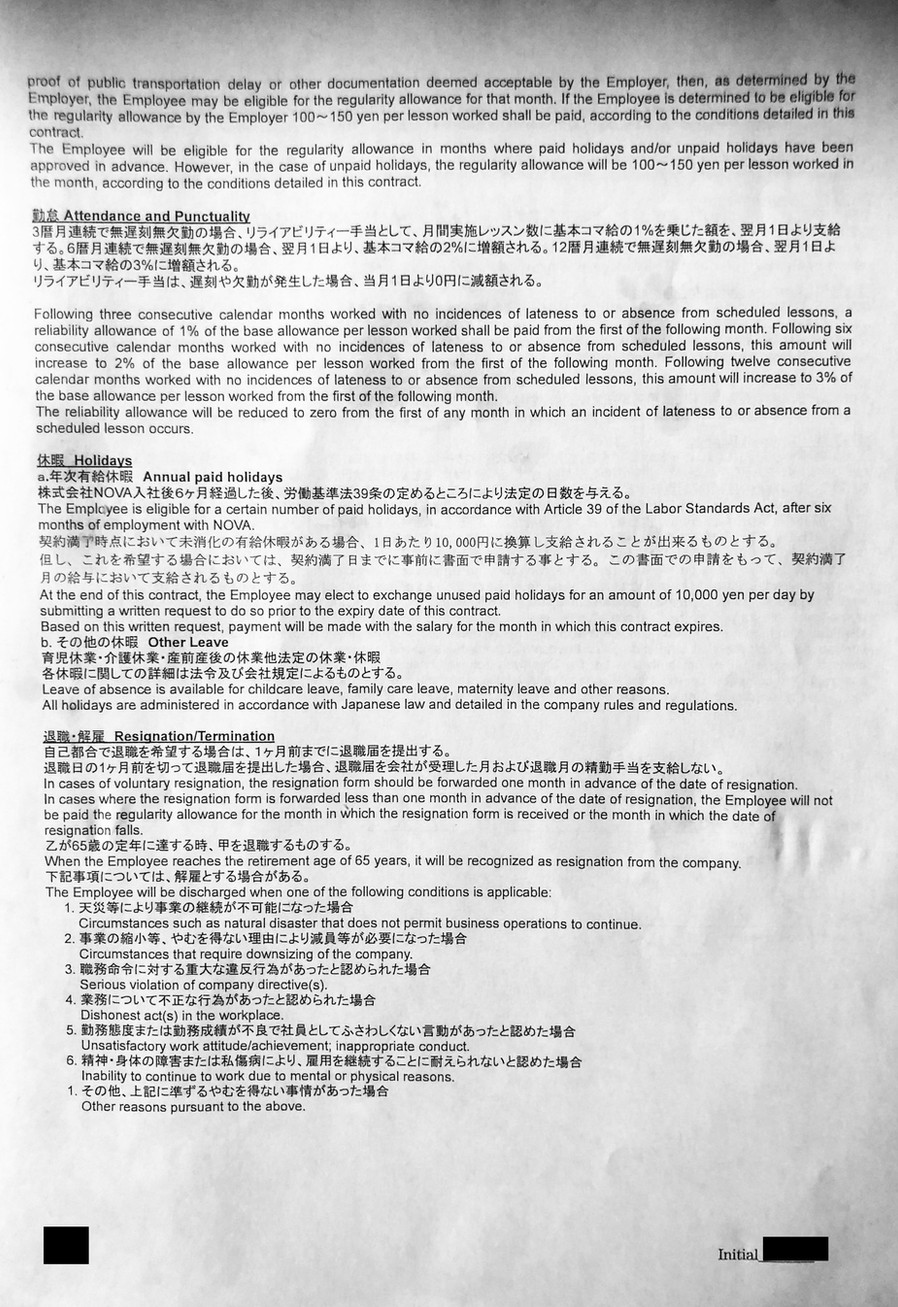


This purpose of this post is to help others identify details that you should identify as red flags which should help you stay well clear of poor quality work.
Remember: This is the more favourable employee version of the contract, not the contractor one where you have to figure out and pay all your own taxes and insurances.
-
Rule 1: Working hours – Avoid any work that is less than 40 hours per week
Under Japanese Immigration and Labour Law, there is no requirement for a minimum number of hours worked, however there is a guideline that exists that recommends that employees should work 40 hours per week. The reason for this is simple. Japan wages are very low compared to other countries, so working long hours is recommended so that the employee can attain a certain amount of income.
In this Nova contract and indeed the contracts of most Eikaiwa workers, we can see that this is in fact only 30 hours and 50 minutes per week. With an average of about 1,500 yen per the maximum of 161 lessons per month, that's a total of 241,500 yen. Realistically, that's for good performing instructors. Actual pay is likely to be lower. Now lets do some maths:
-
With an average of 4.34524 weeks in a month:
241,500/ 4.34524 = 55,578 yen per week
30 hours per week x 60 minutes = 1,800 + 50 remainding minutes = 1850 minutes per week
241,500/1850 = 30 yen per minute = 1,802 yen per hour.
Now let's compare to a starting salary at Uniqlo as a degree owner, working full time.
330,000 / 4.34524 = 75,945 yen per week / 40 = 1,898 yen per hour.
-It is clear to see, that even though Uniqlo staff work longer than English Instructors, they still earn more per hour than the most taxing lessons and, their wage does not change based on the specific conditions of a lesson type. Remember 1,802 yen is the upper range for what an outstanding Nova Instructor can expect to earn. You on the other hand, are likely to earn far less.
-
Rule 2: Salary – Avoid work where pay is affected by many factors
You should never take on any job where your pay is affected by many different factors. This is not only a red flag, but a warning shot, stay well clear!
It is expected that all jobs should have a clear indication of your exact salary.
In Nova's contract, there is are more than two pages(!) dedicated to explaining how your pay is affected. It it literally a nightmare contract from hell itself.
Where on the contract, is a statement of the monthly salary?...
This system of pay is more akin to Devilcorps, such as MLM's and sales/marketing jobs than a real teaching job. People don't believe me when I say companies like Nova are Devil corps in disguise, but it's as close as you can get to one.
Notice how some of the clauses make no sense at all such as 'nightshift' pay. No one at NOVA who is an instructor works between 22:00 and 05:00 am. It's complete nonsense and designed to excite the instructor into the idea of earning higher pay.
The reason the pay system is so confusing is a few fold, they don't want you to know what the actual salary is, or that there is no regular salary. Secondly, they don't want you to work out how much money is being commissioned up to the top of the company; it's a convenient way to hide that you're funnelling money right to the top of the company.
There are also things such as regularity allowance, skill allowance, these may look attractive at first, but are in fact, just another tool used by the company to exploit and excite their instructors to get them to work harder and harder for that extra few scraps more, towards hopefully earning more per hour than an ordinary store clerk would earn.
The only promise you are made in terms of basic pay is 830 yen, which is less than the legal minimum wage in Japan.
That's 996 yen per hour which equates to:
966 30 = 29,880 + 50 minutes remainder = 30,710 4.34524
= BASIC PAY IS 133,442
There's nothing else that can be said other than:
Stay away.
-
Rule 3 – Work Load – Stay away from unstable workloads and shifts
In the shift part of the contract, we see that actually, that figure of 161 lessons, is just a made up figure and that each month has a different amount of lessons.
The truth is, that there is no stable work in this contract. You could be assigned any number of lessons, which means your pay will vary dramatically.
Taking the example from the contract, in November, using the calculations we did from Working Hours, you could earn about 277,500 yen as a really good instructor, but in December earn 174,000 yen. That's 103,500 yen less!
Divide that by 2 and add that to 174,000, gives us an average of 225,750 with a 51,750 yen variance.
In fact, there is no guarantee that you'll get paid that either. Do you get it?
There is no stable work, no stable pay, no stable anything.
-
Rule 4 – Consistency – Stay away from work that has many different versions of the same contract
During my time at Nova, I counted 3 different version of the same contract, the one that we were shown when we signed for the visa, the one that we signed during training and then lastly another one which is 'hidden' on the NOVA instructor online system.
That last one, is much, much longer than any of the previous ones and goes into far more detail.
It goes into more specific details such as 'your persona and image belong to the employer', 'anything you draw, create during your duty, belongs to the employer'.
Avoid any work where there is a lack of consistency between contracts. There should only be one contract only and that is the contract you sign.
Once you are signed onto a contract, you should not under any circumstances be automatically be subjected to another contract that is hidden, for which you didn't sign the terms to, whether it be terms of conditions or whatever else and even if they are disguised as some sort of code of conduct. It should be part of the contractual process.
This isn't just wrong, it is illegal and should be the biggest red flag of all.
-
Summary of Contracts
Always take the time to read into the detail and always have a head strong approach to understanding the contract. If you let your guard down and become a begger, you will accept all of the terrible terms that are stipulated within. You probably won't even notice it's bad.
If you go in with a strong mind, you will be able to spot these red flags and back off. However, it might be difficult for you to do that if you have only seen the contract once you are landed In Japan which as we said before, is a classical tactic used to increase pressure on the instructor. Because now they've done the visa and travelled so far, they're much likely to sign to more undesirable conditions.
Plus, the interview and job application process is designed to weed out anyone who is strong minded, because that person would be more likely to be aware of the terrible stipulations in the contract.
In short, Teach English in Japan schemes like people who are easily manipulated and exploited. People who cannot stand up for their working rights because if they do, they wouldn't have got the job and if they did, they'd be in fear of getting fired, deported or worse.
13 – 'Customer' service
2025/04/10 added a section about how managers exploit the customer/instructor relationship.
Oh that unlucky 13. The question is, is it the Customer or the Instructor? As we will see, it's probably both.
'Customer Service'
one of the key giveaways about the Eikaiwa business. So you as the teacher are being told by your management to 'really care' about your students and to take notice of their interests and to customize lessons according to their interests.
It might be easy to refer to all students as customers, even if their relationship to you is a student.
-
Reason behind Customer bitterness
The type of customers you get at an Eikaiwa varies greatly. It ranges from tots right up to the elderly with an interest in learning English, maybe because they have a son in law who is American, married to their family. It might be something they do as a hobby and mind activity. For the younger ones, they are using the Eikaiwa as a type of cram school, from 10am kids full of energy, to half asleep teens at 8pm. So in all, Eikaiwa's serve a really broad range of customers.
The root of difficulty stems from the way that the Eikaiwa, treat their 'customers' as a source of profit, rather than something that the school really cares about.
The customers are paying in the case of Nova, for extremely high priced lesson packages sold as 'points'. A standard lesson is 1 point, a private so called 'man to man' lesson is three points.
As of 2025/03/23, the cheapest points are on Nova's 47,000 yen (51,700 tax included) package, which gives you 26.4 points. This has been massively increased in price in the past year where packages only used to cost around 40,000 tax included for 30 points.
The specific nature of 26 point four, is quite a joke and shows that the company has a profit margin in mind i.e. It wants to make a certain level of profit, so they've calculated this precisely. In other words They don't care about the customers, only about PROFIT. These companies really are getting so desperate.
This recent price increase now means that:
51,700 / 264 (multiplied the points by 10 so we can deal with that decimal)
=195.8... Multiply by 10 (divided by 10 now gives us 1 point) = 1,958 per point
All standard lessons cost 1,958 yen and private man to man lessons cost 3 points or 5,875 yen.
The bigger package the customers pay for, the more bang they get for their yen. A smaller package though could lead to higher prices per point! So if they get the smallest package available for 26,400, a standard lesson costs 3,000 and a private man to man costs 9,000 yen!
Given that lessons are only 40 minutes, the Eikaiwa essentially rip off the customers 33% of the value of a full hours lesson. In all, the Eikaiwa is charging the equivalent of up to 11,970 per hour for a private lesson, which is just totally sickening.
This ever increasing pricing, puts more and more pressure on the teacher to deliver a more and more exceptional service to serve the more and more demanding Japanese customers.
-
Common Customer problems
Many of the students are the well to do, company bosses, people earning 10 million yen or more, children who are sent to private schools that cost 9 million yen per year or more in boarding fees. The kind of people that can afford to pay 10 million yen for a private golf club membership, simply because they can write it off as a legitimate business activity. That's just how the Japanese culture of buisness works. Great way to do buisness right?
As a result, the customer bring their extremely perfected standards and boy, you have no idea what perfected really means, of Japanese conduct to the lesson and expect you to do exactly the same. That is namely:
-
Don't fiddle with your pen
Sit up strait.
Don't Drink.
Don't Eat.
Don't Yawn.
Don't look at your phone.
Don't scratch your head.
Don't scratch your nose.
Don't sit cross legged.
Don't tap your foot.
Don't bounce your knee
Don't tap the desk with your fingernails.
Don't touch your face.
Don't Sneeze.
Don't cough.
Don't wear a mask.
Wear a mask.
Don't speak too loudly.
Don't speak too softly.
Don't speak too fast.
Don't speak too slow.
-
That's only a few of the countless rules.
During the lesson, you might think that the customer is very happy because they are smiling all the time or appear to be concentrating on the lesson. The truth is that you won't know that until you receive a customer review, saying how terrible your lesson was.
One classic problem at the Eikaiwa that is always spoken about is the instructors voice. For some reason, Instructors have to be extremely loud, otherwise the customers will complain. On the other hand, if you are too loud, the customer may feel spooked. So you can't win.
Some people have naturally very loud voices, so in the Eikaiwa, because the lesson pods, rooms, classrooms, walls don't go to the top (for saftey purposes), the sound escapes. It's possible to hear lessons from the other-side of the Eikaiwa in some cases. So you have to fight to be heard all the time.
At one point, I lost my voice entirely because I was having to shout so much. This isn't unexpected. You're talking constantly for up to 9 hours a day, so your voice box is going to suffer or get a lot stronger by the end of it.
-
Managements perspective on the Customers
"It gives a bad impression to our customers"
From the words of one manager. I was too brainwashed at the time but I should have been thinking "Customers!?"
As explained before, Management really only see the 'students' as money, and expect you the instructor to defend the faux facet of being the loving, caring teacher that everyone wants.
Every now and then, there will be some kind of sale or promotion, which you the instructor are asked to 'sell' to your students. Some of these promotions are totally ridiculous.
One of these 'promotions' was selling a package of 6 'specialized' private lessons for the cost of about 40,000 yen. That's about 6,750 yen for a 40 minute lesson, whereas At the time, it would have usually cost 4,500 for a private lesson if you bought the biggest lesson package.
As the instructor, you are put in horrible position to sell and pressurize the customers into selling these expensive packages. If you don't sell enough packages, it can satisfy the manager that it should reflect poorly in your performance scores.
I remember how the customers would leave with anger in their hearts, not even saying goodbye to me or the receptionist, of which they also worked so tirelessly and hard to sell packages.
As an unskilled English Teacher, most of the time, I just had to make stuff up as an excuse to entice the customer to buy the expensive packages. When I did successfully sell packages, my Instructor performance scores were unusually high for that month.
-
Reports and Lesson preparation.
It would be an absolute joke to say that the reports that we provided students, were in anyway useful at all. In the 10 minutes between ending a lesson and starting the next, you will be expected to score the lesson, with the expectation that you remembered everything about it and then if you have enough time, write a few comments about how it went. After that, you prepare for the next lesson by checking what lessons the student has done, looking at where their weak points are, using some fancy radar chart with a checklist and then unsuccessfully finding a lesson that was most of the time, completely inappropriate for their needs, because you had no training on how the system worked apart from 30 minutes during initial training.
The whole system is a complete shambles because you know what the student is weak in, but you can't find the right lesson, or the student has sat the same lesson so many times. Some students have stayed on the same level for years and years, completing hundreds of lessons in the same book, yet not levelling up (wasting their money I ask?).
Then there is the problem of trying to find a lesson that you understand how to teach because some of the lessons are just completely void of interest or are a complete mess. Apparently, this is your 'skill', to take a messy inconsistent textbook and understand how to 'teach' it.
The worst of the worst is Kids lessons, where you have to organise varying amounts of resources in a limited amount of time. To say that it's 'Limited', ah ha ha...
Take my old Company Nova, they run several Kids classes, just to make things simple, I'll skip the ages. In ascending order: Baby, Kinder, C5, C4, C3, C2.
It could get messy talking about the details of different classes and it doesn't help my argument to do so, so I'll skip it and get to the point.
Going from Kinder to C5 is the absolute worst. Here is a list of all the things you need to do, between a Kinder and C5 class within 10 minutes:
-
Get the kids out of the classroom, some struggle to put on their shoes, other's won't leave.
Take the Textbook out of the classroom. Best to bring the flash cards and CD to save having to go back in.
Get all the kids together
Give the lobby service.
Do the promotional presentation if there is one.
Go back into the classroom and raise the table in the room (It's adjustable and goes down for Kinder, up for everyone else)
Bring in as many chairs as needed into the classroom from another classroom because all chairs have to be cleared out for Kinder lessons.
Complete all of the reports and scores for the Kids in the Kinder lesson.
Put away the Kinder Flash Cards and CD.
Put away all the Kids stickers in the correct place.
Get out the C5 Text book.
Prepare the correct Flash cards, there are three different sets of cards for this class. Make sure they're all there and none are missing.
Decide what games you are going to play.
Put the CD into the CD player starting on the right track.
Prepare spare paper into the classroom to play the special game at the end.
Do all of the above while dealing with kids that don't do as they are told.
-
In fact usually, I would prepare as many lessons as I could in advance, because it was simply impossible to prepare the lessons in the time we actually had. It was even worse if one of the managers was there and started talking to you about how your lesson went while you were trying to prepare for a lesson. It was even worse if the branch was a disorganised, total mess and and you ended up spending half of that time, looking for the resources you needed for the lesson, or not being able to find them at all. You sometimes wondered how the school even ran it was so disorganised.
You are told during training that it is completely required of you for you to enter the classroom, during the chiming of the bell, which is just a digital version of the Big Ben chimes. If you're not on time, you're late for the lesson. That's your regularity allowance gone and a 2 for Diligence on your Instructor performance score.
There was never enough time to complete the student's reports between these extremely busy times. So the reports would get left, sometimes for up to 3-4 lessons after, for me to complete them.
Most Instructors including me, did 45 minutes unpaid overtime before our day started, just to prepare all the materials. Often it would actually take that amount of time, right up until our first lesson, just to prepare. We only formally got paid from 5 minutes before the start of the first lesson, of which it would be completely impossible to do that.
Branch rules meant that nothing could be left out overnight, so you have to prepare all the materials before the lesson. That's 40 minutes of pay, cheated almost every working day.
-
Conclusion around customers
Good customer service, is the absolute foundation of any successful business. If the customers have a great experience, they'll come back. We've heard that all the time.
Foreign English Instructors are to the Japanese, Idols and characters and therefore you're expected to act like one and you'll get treated like one, whether it's dancing and prancing in front of Kid's in a suit and tie, or being some kind of clown or gesture for some curious teenage girls who want to meet a foreigner.
The bottom line is, that the only customer service, comes from you, the Instructor and the lady/man at the front desk. The management, just see the customers as profit. Plus, they don't have to teach any lessons.
They exploit the relationship you have with your student, by making you sell extremely expensive packages that no sane person would buy, and to test you as a salesman/woman.
Because the customers ask you personal questions all the time, it's a great opportunity for management to find out more about you as well, so that they can use that information against you if they so wish to. It is often said in Japan, that you should never diverge your personal life information at work, but it's near impossible to do that in the Eikaiwa because you would come across as cold to the customers, but it's a catch 22, where if you do, the management have their ears open.
So what do you do? Sit there as the instructor and pretend that you actually care about the students and their learning? While actually becoming a liar and a manipulator for profit and to make your manager happy because his commision has increased?
It's clear why the company doesn't want you to fraternize outside the workplace with their customers, since otherwise they would lose that grip of being able to exploit the customer for profit.
They are using you, the instructor. Using your personality, your smile, your energy, your persona, exploiting your kindness, your generosity, your paternal care, your nurturing care. They're exploiting that special reason that inspires people to want to teach professionally, for their own profit, greed and growth, without a care in the world about your welfare as the instructor.
Yes they exploit you as the instructor, but they are using your students, too. They know that student has that special relationship with you, that they will do just about anything to come back and see you every week. That makes it all the more easy to sell expensive products and services to them.
No student deserves to be treated as something to be used and exploited and it's no wonder, that the customers are so often left angry, lashing it out on the instructors by giving them poor scores and getting them into all sorts of trouble.
And all the time, the prices for the customers keep increasing and increasing, while the instructors pay keeps dropping and dropping.
14 – Work Culture, Kids and their reports
Work Culture
So, what is the Work Culture behind all of this 'Teach English in Japan' like? It stinks for sure.
It's mostly driven by the kinds of people I talked about in the 'training' part part of this series; People are a really arrogant, heads buried in the sand, only there to teach English because like the rest of the TEFL world, it's all very temporary and high energy; you work one place here for a while, then another country, then somewhere else. They might have some plan for Japan, they might be passing through. To the Eikaiwa, none of it matters. They don't care, they only care about what you can do for them, full stop.
More than anything else, working at the English school fostered some sort of hatred inside me for Japan and Japanese People. It's not there now because I know that it was a result of working at a company that manipulated me. Maybe it was the terrible customer reviews that were preventing me from moving forward in my so called 'career opportunity'. Over the course of the last few months at the Eikaiwa, I was getting more and more of a grudge and my energy turned from being really happy and positive, to one that was darkened.
I hated the fact that my work was keeping me away from all the Japanese festivals, where all the cultural events were happening. I hated that all the foreign classes run by the local government, designed to help foreigners, were on weekends when I was working. I hated the fact that I couldn't find anyone in my area who spoke English. I hated the fact that I was trapped in this company. But that's exactly how the 'Teach English in Japan' scheme works.
I now realise that I was totally brainwashed. I was completely out of my mind. Why on earth would anyone think that they would find people who spoke English in a country like Japan? What an utterly stupid mentality.
My own arrogance was my own downfall and it was an arrogance that was nurtured by the Eikaiwa. 'No Japanese' in English lessons, don't speak Japanese to customers, don't speak to customers outside of the workplace. Don't even refer to Onsens and Onsens, they have to be called 'Hot Springs'. By all means say hello and have a small talk conversation, but no drinking or any formal arrangements.
-
Get ready to fight
We've already talked about how bigger role Key Performance Indicators (KPI's) are in the Eikaiwa and how it affects your pay, your treatment at the company, and ultimately, whether or not your get your contract renewed or not.
The reality of that is reflected in the work culture. Every Instructor, might be nice and friendly and professional, but this is work culture, everyone is fighting, fighting to keep their jobs, fighting to get that promotion, working so, so hard. A promotion means that they have greater security. Becoming a Manager means that you can stay for as long as you want. Everyone is fighting all the time.
It all depends where you are placed. You might be placed in a school full of very weak instructors and get very quickly promoted to a supervisor role, because you stood out amonst all the other instructors. On the other hand, you could be placed in a location with highly experienced instructors like I was. All of my colleagues had around 5 years experience, some had 10, some even more.
It matters, because you are competing against them, your supervisor it used to their level of skill and your scores are compared against the other instructors. So If you're a weak instructor surrounded by highly experienced ones, your Performance Indicators will be complete garbage.
At a low level it's frustrating, at the high management level, they look at the scores and see that you're not doing well, then graft in another instructor and then have the poor instructor kicked out, or transferred to another location – at your own cost and liability.
It is simply, a survival of the fittest.
-
Kids are NOT well behaved in Japan
I suspect everyone is mislead into thinking Japanese Kids are really well behaved, the best in the world. They do as their told exactly and are a joy to work with.
You couldn't be more wrong. Japanese Kids are like kids from any other part of the world. When they have to come to your lesson on a Saturday or Sunday, they'll let you know.
The number 1 important thing the Eikaiwa care about is “make lessons fun”. Yet again, another top down slogan that has no quantifiable meaning or definition. Exactly how, do you make lessons fun then? Dance and prance? Play games? Become an Anime Character?
That way of thinking means that there is no room for any kind of discipline. In fact, your job application will be automatically rejected if you so much as mention the word at any stage of the process.
That makes managing the classrooms as close to the end of the earth as you've ever been. Kids who don't listen to the teacher, fumble around with pens, throw things around the room. There were even a few really difficult kids who would kick, scream and scream, go into complete tantrums. There were kids that attacked each other in the classrooms. Kid's that would pull the posters off the walls. You name it, it happened.
At any stage, there is no possibility to discipline them because the lessons have to be...FUN!. Some of the English schools have windows to the classrooms and often, the parents will be staring through the window into your classroom, so every little tiny weenie detail, is being perused. there's no room for one single mistake.
I would greet the Kids as they came in the classrooms, some of them would just start crying immediately before they even entered at the sight of my face. Some wouldn't enter the room. It made me feel indescribably terrible. The Kid's take a liking to you, or they don't really, really fast.
All the time, I didn't know what to do because I hadn't had enough experience and training. I didn't know why Kids weren't listening, were not following instructions, how do I get this kid to stop playing with their pen and to draw in the exercise book.
Companies like, Nova expect us to use our 'Paternal' skills to essentially babysit these kids, but to also complete everything in the lesson.
Sometimes, I was dealing with up to 8 kids at a time on my own. I had to work so, so hard in that classroom that I would quite simply run out of energy after 2 classes.
At Nova, Kinder and C5 are the most challenging. As the Kids get older, they very, very quickly calm down and became the stereotypical, gentle kids that so many foreigners stereotype.
-
Kid's Reports
Every so often, we would need to complete the Kids reports. This sounds really formal and proper but all it is, is a single sheet of paper, with some fancy numbers on it which we fill in according to the ability of the student.
We had, No training, how to do this whatsoever. We were not even told during training, that we would be completing these at a later stage. I thought the only reports we did, were the ones we filled after the lesson. But then Out of the blue, I was told that we have to complete these reports and that I had a good 100 kids reports to complete.
It took weeks and weeks and when I completed them, I was then told they were no good. That I had given the students poor scores and as a result, customers had left the Eikaiwa. I was told that I wasn't detailed enough in my reports. The simple truth is, I couldn't remember that kind of detail because I hadn't been trained to notice it. Let's be honest. There was no way that I was accurately making those reports, because it was just impossible to do it.
Then I was told “If you don't remember it, we can give that student to another teacher”. To unravel that, it translates to “If you don't care, we will take away from your pay check”, since students are just really money in the mindset of the Eilkaiwa. 1 Less kid per class is 400 yen less per month.
I know what you're thinking, what an awful mentality to think of Kids as money, but that's what the system, is encouraging you to do as the Instructor. (more about this in a future post)
The Kids are being totally failed at these Eikaiwa by untrained instructors, some of which have no clue how to work with kids and are simply not there for the wellbeing of the students.
15 – How much profit do these companies actually make?
Over the course of an hour, I created the 'Eikaiwa Calculator', in an attempt to find out how much money is actually being made by these businesses. I always knew that I was getting a poor share of pay even while working at the Eikaiwa, I was always complaining about it to my girlfriend, but now I want some accurate figures.
-
So here on, is my method for calculating:
I'm basing my schedule on that of an average Instructor, considering that every one of the 35 lesson slots is full.
I've calculated it twice. The first one is based on an outstanding, A grade instructor, with 5's across the board. Almost totally impossible, but those in the top 5 instructors category, might have such scores. This is so I can show the maximum possible pay. Don't be excited, a vast majority as in everyone else, doesn't get those kinds of scores, so;
also included in my calculations is a second pass for a really poor instructor who does not get paid any sort of allowance for their skill and who sometimes misses lessons, so they don't get their regularity allowance.
Also bear in mind, not ever single instructor in the country is an A grade instructor with perfect scores.
Lesson prices are based on the cheapest lessons that the students can buy, which is through purchasing very expensive packages that cost over 50,000 yen. Note that packages are designed so that the student always has some points left over, so they are enticed to by more packages so they can make up that decimal point as a round figure, which can be used for a lesson. With the 26.4 point package for 50,000 yen, the student has to buy 250,000 yen worth of packages to get a round number, i.e. 132 points, 132 standard lessons or 44 private (man to man) lessons.
Income from Kids lessons is based on the package that offers 8 lessons per month including the advanced, which is known to instructors as 'plus' classes. Some kids do them, some don't the different between each is a matter of 10's of yen.
Note That I've taken instructor allowances into consideration based on the size of the class, class type, regularity and skill.
The National figures at the bottom, are based on the number of branches in Japan rather than the instructors because it would be messy to deal with part time workers, and other workers.
I could base it on two lessons happening at a school at any given time, but we also have to consider that most branches will unlikely run 2 classes of 8 kids at the same time. For this reason, the branch and national values are multiplied for 1.5 to split the difference of two instructors working at a branch. Calculating the specific lessons and entire branch would be infeasible as it also includes online lessons.
I can confirm from my own experience that this calculator I created really shocked me at how accurate it was, so please be reassured that the figures calculated from this tool are likely to be as close close to real life figures as we'll ever get. I really don't have the tools or the time to sit down and work out, branch by branch, instructor by instructor what money is actually made. It's impossible to do because it's just so messy.
I have no idea of costs either. We could attain from NOVA's diabolical 'pay 6,500 yen compensation' policy, that this is the cost of running a lesson. I highly doubt it's true though, so I'm basing expenses on: Cost of instructor, cost of the receptionist, cost of the maintenance.
From an inside, source, I've been told that the costs of running the school per lesson is in the region of 4,500 – 5,500 yen. I'm then calculating from there, based on deviation in instructor and receptionist costs. Other costs mean things like energy bills, any licensing, rental of store front (some Eikaiwa's are based in larger malls which they have to pay for, some in converted office space), there might also be other costs that I am not aware of. Other costs will therefore be set at 2,500 per lesson. This seems to give the most accurate results based on what I've been told by my inside source.
The Table is colour coded to represent different days.
-
Note:
The percentages are only correct when the profit is not in the red.
-
Conclusion of profit
Standard adult lessons of 1 and 2 students, pay the instructor well but the Eikaiwa hates that because they make a loss.
Kids lessons are popular with Eikaiwa for obvious reasons, they make a lot of money. While you're struggling with 8 kids, the school is pocketing a whopping 12,000 and more, which is about as much as it feels it should be worth. The instructor gets as low as 13.38% commission of that income, not on the profit remember, all of the profit, goes up the chain of the company.
It's also clear to see why the Eikaiwa push instructors to sell the more expensive so called 'Man to Man' lessons, as they get a little bit of profit from that, whereas the standard lessons with one adult in them lose them a lot of money.
It's easy to see why supervisors are not keen to mark the instructor scores too highly because if they did have an A grade instructors with 5,5,5,5 on their Instructor evaluation, they would would loose even more money.
-
The dirty secret
If you compare the two sets of figures, you will notice that the 'possible earnings' that the instructor could be earning are actually the same.
So all that work that you're putting in to be a great instructor, is actually not additional money, but an additional share of profit if you like. If you're performing poorly as an instructor, all that's happening is that the company is taking more of your potential earnings for themselves as profit.
Remember, I'm talking about an Eikaiwa that runs adult lessons as well as kids. However, many Eikaiwa run kids only classes, so they make even more money and the instructor, is even more worse off.
You don't actually get paid commission directly. Instead what you get paid, is based on what's in your contract. Take Kids's lessons, Every additional child that you have in your lesson beyond 5 kids, you get paid wait for it. 5%, of what that company claws back. For the parents paying 2,000 yen per lesson for their kid, you get paid 100 yen addition. You don't even get paid any more than a 200 yen bonus, until you have 5 kids in your class. So, for a lesson of 4 C2 kids, you get paid, the equvilant of less than 2% commision on the lesson taught, a measly 200 yen, while the company claws back 10,280 yen.
Remember, when calculating the expenditure, I'm talking about the instructor being an expense to the company, according to the contract we spoke of before, paid by the gross profit. Once that expenditure is paid, it's all net profit for the company.
Despite all that, there is still enough money for the CEO of NOVA Holdings to be worth at least over a billion yen per year, given that they own 80% shares over all of their subsidiaries. There's still more than enough money made in profit, to pay the management vast sums of money, which could support the kind of hierarchy we previously explored, where IM's and National mangers are earning in excess of 10 milllion yen.
-
Why it matters
It matters because as stated many times in my posts, if you were able to work freelance in Japan which some very fortunate people can, you don't need to tie yourself to a company with all these peripherals, store fronts, receptionists, fancy IT, scanning ID equipment. etc and you could earn some decent money.
Yes there would be the challenge of finding enough students that would want to have lessons with you, compared to the overpowering advertising campaigns of Eikaiwa's using attractive female co-stars. But if you don't actually have any legal connections to Japan, you're stuck applying for work at a scummy company, in one way yes but more accurately, you're just really making yourself vulnerable to being exploited bythis kind of company that is sucking up all of your potential income and rewarding you, or punishing you, based on nothing but personal bias and discretion, given the factors when we were discussing Key Performance Indicators, just because they know that what you really want, is to live in Japan, full stop.
It doesn't take a genius to figure out that Eikaiwa like NOVA are really ripping off instructors big time. We're talking less than 20% commission in some cases. In one of the columns, notice the commission. This is the percentage of 'commission based pay' that goes to the instructor in comparison to the profit made by the company (do ignore the ones with a loss of profit). This Profit is funnelled up through the company after paying the staff, the instructor and everything else, so all that profit, is free money that goes up the chain.
The Actual Monthly profit, shows how much money the company takes back as profit. Even if they were loosing the most money because the instructor was A grade. They would still be making a profit and in addition, the Instructor would be getting so many man to man lessons, full kids classes and full adult classes, that the company wouldn't be loosing any money, ever.
The point is, all of thay monthly profit, could be your paycheck and it many ways it is your paycheck, what you could be earning if you were working freelance or running your own buisness, but it isn't and it never will be, no matter how good of an instructor you are because the only way to earn more, is to go up the chain.
Gaba is even worse than Nova in that you are really made to feel that you are running your own buisness or lessons and that really is a total devilcorp situation because it fits MLM perfectly. The only difference with being employed at Nova, is that to some extent you are an employee, so at least the psychology is different, but, the point is, all of this could be really harmful to someone who was approaching a company like Gaba or a contractor arragement at Nova, believing that they were running their own show. Even if you are an employer, you're in no better position, other than not having to deal with paying taxes and insurances.
The only safety net so to speak, is when the Eikaiwa does loose money, then at least you still get paid, but who knows, in the future this will probably change as well. But the overall picture, is that the instructor looses out, always.
16 - Escape and Closure
2025/04/10: Added the Section "The Reality of 'Conversation Schools'"
-
Now it's time to talk some difficult truths.
The worst part of the whole 'Teach English in Japan' scam is the sense of being trapped and that's because you are.
We know the drill, it's been said a million times in a million different posts about Teaching English in Japan... “You're trapped in a foreign land, no-one speaks English. Working anti-social hours, bad pay, terrible management." We've been there, done that, we know it's isolating.
But let's dig deeper. What do you actually get out of this time in Japan at the end of it? Rather to be more precise, what do a majority of people get out of it? The answer is, nothing. Actually in some cases, you end up with less, than what you had before.
When I was discharged from my Eikaiwa after I had a mental breakdown (I wrote about it a while ago on teachinjapan), I had 2 weeks to find a new job and apartment, it was near about completely impossible. After that, I was spending 50,000 yen per week, on hotels, hostels, whatever I could find and afford. I even bunked at my friends for a while. Hear me, It's not like that you can just jump into another job.
I wasn't just out of a job, out of an apartment, I was completely broken from the inside out. My partner who had been a source of comfort, had cut me off and I had an ordeal with that. I was full of vexation, my attitude was awful for the rest of my time in Japan. I was lugging around more than 120lb of luggage miles and miles from hotels to trainstations, up and down flights of stairs, escalators. I was constantly harming myself, in public too. I had lost my mind completely. I was in the mindset that everyone in Japan hated me and I was completely off the rails to say the least. At that stage, you're a lot cause in Japan. Mental health support in Japan doesn't really exist, so those that fall, fall and keep falling forever more. I dread to think where I would have ended up if I had stayed any longer. All the times I ended up self harming, not a single person would stop and help. Why would they, this is Asia. There's no mental health support, if you become ill, you just get thrown out like rotten fruit, full stop.
I honestly, felt betrayed by the Teach English in Japan scheme. I felt that I failed the staff, the students of the people I tried to help at the English school, I failed the person I loved so much. I failed my family by not developing my life in Japan and providing them family and grandchildren. I failed the people of the job I had left before going to japan, who struggled because they couldn't find an adequate replacement.
In the end, I gave up the job hunting and decided I was wasting my time. I might as well just spend some moments in Japan doing the things I enjoyed before moving on. But it wasn't over just yet:
I had to borrow money from my family to pay for a flight home. My final pay check was less than 50,000 yen after the Eikaiwa took 100,000 yen to pay for the company apartment and clean-up costs, which was in-fact all of my paid holiday that I was made to take before resignation. Even if you do your best to clean up, they still charge you a cleaning fee. Had I been living in my own flat, I would have been paying even more in charges.
When I got home, I had to sell my own possessions to make up for lost money and to pay other expenses. I lost about $4,000 worth of possessions because I had to sell them. In addition, I lost all the money that I could have been making, while living in my own home in a decent job earning $100 an hour.
I felt afraid to leave the house, I didn't want to talk to anyone because I felt that I would be judged, in the same way Japanese customers treated me in the Eikaiwa. I felt out of place now that I had adapted to Japanese culture and society. I didn't have the confidence to apply for another job. People at home thought I had turned my back on them and felt that I wasn't culturally aligned with my own home country. In short, it has felt as if my life has been completely screwed up.
In the grand scheme of things, Japan was just... nothing really, it was made a weird blip in my life. The more and more time goes on, the more and more I realise how invalided and irrelevant the whole experience was to the point of realising how stupid these 'Teaching English in Japan' schemes, actually are. What I threw away to chase... nothing. Most of the memories I had in Japan are all so meaningless, empty and of no value to my life whatsoever. Nothing that I did out in Japan, helped me to build anything in my life at all, rather it actually took away.
The company might complain about how instructors 'Don't live up to our expectations', but they don't care a microgram, if the instructor feels the same about the 'opportunity'.
It's vastly because of that, that I really do feel essentially scammed. I lost my time, my money, my energy, my job, my soul and I've got to rebuild my life again.
-
The Reality of 'Conversation Schools'
Think about it, you are categorically told to 'have a conversation' with your student. These companies are literally called Conversation Schools. In reality, if you really think about what you're actually doing in these 'lessons', you're actually just a salesperson.
If you like, you are selling your profile, your persona, you're image and the company is exploiting all the relationships that you make out of that to make a profit. You're near enough prostituting your own personal life, to make the bosses money and to sell their products; which is why the customers are so inquisitive and ask you so many questions because they generally think that they are making an actual student/teacher relationship with you and as the instructor.
That's why the company doesn't want the instructors meeting students outside of the school because what they really want, is for the instructor to be so attractive to the customer, that they'll spend thousands of yen on that Man 2 Man lesson because having a lesson which is just a conversation, is the golden carrot they dangle in front of the customers.
That is the conversation school. That is what the business owns, you're basically exploited to have a conversation with a Japanese person, who speaks some level of English. In a way, the business exploits Japanese Customers too because it's so hard for Japanese to meet foreigners. It's expensive to travel to an English speaking country (but then it's obiously in no way, a problem for Native English Speakers, so desperately wanting to live in Japan then), so the conversational schools are literally in NOVA's own words: 駅前留学: Study Abroad in front of the station, that is the businesses, meet foreigners in front of the station.
On This thread on TeachinginJapan, someone likens these Conversation Schools to the 'Meat Market', as to suggest that these conversational schools are in fact, some kind of dating agency. Given NOVA's anti-fraternisation policy, I doubt that is probably true, but there still is a culture (again from inside sources) that suggests that some students behave very questionably in the lessons.
So it happens that these companies have found a really clever way to disguise talking to someone as 'English Teaching', which falls under a visa category. Foreigners get to chat with Japanese, Japanese get to chat with Foreigners, make it into English Teaching School, make a whole lot of English teaching materails and get the 'Instructor' to 'teach english' to disguise the nature of the business and then you are away!
You're just a salesperson, who sells their soul and persona, so the company can exploit the relationship you make with your 'students', to make a profit. That's the reason there are 'no skills required'.
-
Why have I called it a scam?
These companies take advantage of your interest and passion for Japan. Ok, Japan is a really tough place to be, just like many other Asian countries, but it's probably among the more adaptable ones, in addition to Singapore, which is probably the best for English speakers.
These 'Teach English in Japan' schemes target people who are fed up of their lives. People who want a career change, people who value happiness over wealth, thereby are happy to live cheaply. People who are intrigued by travelling and experiencing different societies and cultures.
These 'Teach English in Japan' schemes know that and so they entice you by making it as easy as possible for you to enter their company. “no experience required”, “No Japanese required”, you can just apply, we will do the visa and there you have it, you can live in Japan, within months, even if you have no relevant skills. It's all about getting you in really quick, and in most cases, out really quick too, in the same way MLM Devilcorps do.
These 'Teach English in Japan' schemes take what is a most precious dream to many, many people and they rip the hearts out of hundreds, if not thousands of people every year, including the people of their own country if you consider black companies. Right back from the first part of this series, we looked at how Japan's tourism industry, get's you hooked into 'Japan', as this magical, fairytale like place, with no crime, absolute safety, beautiful women (and men can't be left out), beautiful nature, temples, shrines, the best food, manga, anime, Onsen, the list goes on.
It's a scam because you have to pay your own money, for a flight which should be paid for by the company. You have to pay for your own visa and travel to the Japanese embassy. You have to pay for a hotel while you have your training. Then the 'Teach English in Japan' schemes pay you, the absolute minimum for you to survive. It's just enough to live but it's not enough to build a life with.
It's a scam because only a very few (aprox. 0.02% from the time of first application), make a success out of this 'Teach English in Japan' scheme and get to stay in Japan long term, either because management moves them on, or they simply break down like I did, from the diabolical working environment. Believe me. You can try your very best in this job, and fail catastrophically. In fact the more you try, the more you fail.
It's a scam because nothing about the job in anyway, is in your control. You can be the most experienced genuine and lovely person, but it might be that you are placed with management that don't like you and customers that don't like you. There are so many peripherals and variables that determine your success, without having any control over it. Nice people don't do well in this job.
It's a scam because there's no Job stability. You're being renewed every 12 months or even less, by the company and then looked at again by the immigration authority. At any stage, either one can say no and your journey has finished, there's nothing you can do, especially if it's immigration.
It's a scam because if you do get 'discharged', you're left without a job, without an apartment and if you're on your own, you are on your own. But then you have to pay for the cleaning fees for the apartment, for somewhere to sleep and for a flight back home and then travel from your airport to your home. None of these are expenses that the English school will pay. They don't offer any kind of insurances or protections against it and they don't check carefully enough in the first place, to ensure that the successful applicant, has a good chance of being successful in the company. They even have the audacity to even ask 'do you have enough money?' when you apply!
It's a scam because thousands of people leave Japan deeply scarred, hurt, feeling betrayed, disappointed, having not achieved their goals. Some of the trainees I knew, despite being real experienced teachers, left only months after starting, realising what they had got themselves into. Some people might really believe they are entering into a stable, professional job that will give them long term happiness, and financial/life stability, but those factors are completely out of their control before the job even starts.
It's a scam because fundamentally, the company is based on profit. Students are just profit for the company. Kids lessons, just help the company make more money and that way of thinking becomes your way of thinking. You literally become someone who wants to get more students into the school so you can make scraps of extra money and increase your pay-check by as little as a 2% cut of net profit, a few 100 yen's raise. This is what the system is indoctrinating to you.
Most Instructors are just there for the visa, to live in Japan and they really don't care about the student's they teach, including the kids. The instructors are there for fun and themselves. Forget about serving the company as an employee for a moment, I'm talking about basic, outward looking, nurturing care for students and kids.
Having more kids in classes becomes more money, selling that adult a really expensive lesson package or man to man lesson, is more money in your pocket and a boost to your Key Performance Indicators, so you can get even more money and preferential treatment.
But all the time you're doing this, you don't realise just how much more money the company is making by exploiting your image, persona and hard work. Nothing about the way these businesses run, suggests any kind of nurturing, care of anything that relates to the interests of professional teaching. NOT ONE TEACHER I've met in my entire life, teachers who worked in real professional positions in real state schools, high schools and colleges I add, ever said that they teach because it's good money, or it helps the school or their boss earn more money. They've all said that they love helping others, supporting and guiding their students and saying how fulfilling it is to see their students happy and what difference it makes to their lives. There's no mention of money.
It's a scam because the managers use all this fake terminology to give the impression that they are experts in the English language, while in reality having thoroughly searched for it online myself, I've never come across any of the words and terms they used, in any official source, not in the Merriam-Webster's Collegiate, Oxford or Cambridge, not even in Google search. It's again, something that helps sell themselves as professionals in the same way that dressing in a suit and tie does.
-
Closure
But if I were being more honest, the real scam, started with me:
I was the one who was so desperate to live in Japan, that I choose a job I would never have thought of doing, or would want to do, in the name of living in Japan. I, like so many others, was so desperate that they were willing to give up a well paid job, to work for as little as less than $6 an hour. I did it because I was fed up of money, living a life I didn't want to live. I was the one who was willing to pay $3,000 for flights and other expenses. I literally wanted to be poor because I felt it was more important to be poor and happy, rather than rich and unfulfilled.
Where did that get me? I'm not just back in exactly the same place I started. NO, I'm actually worse off than where I was before, because now I don't have that $100 an hour job and I don't have any money. I have to now explain in my CV and interviews why I went to Japan for a year.
Was it worth it?... No it wasn't. I got to live in Japan for a year, all but a blip in my life. I made some girlfriends while I was there, but in the grand scheme of life, they must have seemed like hookups to anyone else, though I really tried as hard as I could, in the hope I could establish long term relationships with my job and potentially, my future wife. But I ended up really ill and loosing everything.
Instead, I could have used the time I spent in Japan, to continue doing my job here, I could have travelled again to Japan to spend more time there. I would have been wealthier and who knows what might have come into being. Instead, I can't even afford to travel any more. Could I even face the long haul flight back there again? I'm worried about how I will feel if/when I step on Japanese soil again.
There is no beating the 'Teach English in Japan' scam. It will always be there, offering short term job solutions to foreigners. But the truth remains the same. These lowlife companies are only interested in short term workers, people who they can get in on the cheap, work to death and then eject out, with no responsibility or liability because for them, it's cheaper and more productive. No Unemployment insurance to pay etc. etc. It's not that the Japanese Government support it, Japanese Companies demanded it, and the Government said yes.
Yes, the image of Japan as a beautiful place of shrines, temples, nature, good food, culture and people is captivating for millions upon millions of people, but if Japan as a whole allows scummy companies to take advantage of foreigners like this, they are damaging their own reputation and undermining the reputation of Japan. It becomes difficult to find any reason why all this tourism exists other than to allure foreigners into horrible working conditions, to do the work local Japanese people don't want to do.
Look at the people of Japan. Most of them are unhappy, depressed. The people on the train are half asleep from being completely drained to the last 0.1% of their energy, by their 16 hour per day, 80 hour work week, people who live to work, their entire meaning of existence, reduced to slaving away on minimum wage. The only Japanese who are laughing and having fun are those who haven't been in work yet, elementary, middle, high school and university students. You walk the roofed shopping streets of Japan and not a single shop is open. It's barren extinction, void of life. It's the literal end of the world. It hurt the soul, just to wander down those streets. Is Japan really this magically, fairytale like place we've all grown up with?
I find it so difficult now, to look at manga, anime, the temples of Japan and indeed most things Japanese, and not think about this other, darker side of Japan, that I've experienced. I can't say that it wasn't Japan either, because all of what I experienced, happened on Japanese soil. I look at the souvenirs I bought in Japan and think to myself, all the money I spent on that junk that I don't use. I just don't feel about it in the same way.
If Japan wants foreigners to work in their country, they will need to respect the expectations of foreigners. That means offering secure work, good working conditions, paid flights. We don't want to be millionaires, but we do want to feel that we can live a quality of life that leads somewhere.
If I ever return to Japan, I will certainly never feel the same about it, as I did when I got my residence card, went out of customs and walked to the train station and thought, “oh my gosh, this is the cutting edge of my life, this could be the moment that I look back to for many years to come”.
Instead, I was walking back across the same flooring a year later. My brain couldn't even process that I was actually leaving the country. I was in disbelief about it. I literally was the closest as I've ever been to living my life in the moment.
All of this has lead me to the creation of this series of posts and this subreddit. I've taken a hard bashing at the 'Teach English in Japan' scam for a while now, but there has to be a point where to really move onto the next phase, it has to stop. I cannot keep living in this mire that I'm living in.
I know that 'Teach English in Japan' schemes are complete cesspools and should probably be rebranded as 'Teach English in Japan Experiences', rather than formal jobs, but behind that are real faces, people who are still trying hard, fighting to keep kids entertained. Managers working out how to keep the buisness alive, dealing with terrible instructors like I was, rising costs, as long as they can. They're all trapped in it too.
That's where my journey is transitioning to now, away from the darkness of the past and towards something better, where I can find a place for Japan in my heart, in a way that I always wanted it to be, rather than through the vice of someone else.
I want to keep asking myself 'Why Japan?' and to keep asking and seeking for that. But I can't achieve that here, while essentially wasting my life writing about something that isn't going to change, something that fills my soul with anger, unrest, something that I hate and thus, will never lead me to a fulfilling life. I can't change the ways of scummy companies that exploit people. You can't do much about it either. I can't change the fact that there will be an endless supply of wannabe Japanophiles and weebs, so desperate to live in Japan, that they will continue to apply and accept these 'jobs', if you can call them jobs and a number of months or years later, leave, completely broken and wonder why they were done over. There's nothing I can do.
In all finality, I think the ultimate lesson I've taken away from all of this, is to be honest about yourself and what you really want in life, being aware that there are many things in our world that impregnate us with false dreams and aspirations. Social media, with Mr. Foreigner and his Japanese wife and Baby, or Mr. Japanophile going round saying how Japan is living in the future and is so much better than every other country in the world, certainly does not help leaving people feel that they are truly free.
Do you really want to Teach English just so you can live in Japan? The sad reality is saying it and seeing it, seems totally fine, but do people really know how stupid a mentality that actually is? I certainly feel stupid now looking back at how I posted my CV, with a picture of me posed with a smiley face, suit and tie with the title of 'Teacher' on my CV.
I, was the charlatan, I was the one who from the outset decided to try and enter a job, so I could live in Japan, even if it meant pretty much faking the fact that I was in no way shape or form, a professional English Teacher. In many ways, I was the scam and as they say, what goes round comes around.
Having said all that I've said in this series, there are people who do find Teaching English in Japan to be a positive and uplifting experience, filled with memories and joy and even now, I do admit, I remember my students, It almost makes me happy to remember the smiles on the kids faces, their laughter and the for a few brief moments, I might have actually enjoyed the job to some extent and found some peace, even if it was a gold nugget in a mine full of coal and soot.
That is real teaching, not having to think about how much money I can make if I get an extra few kids in my class. Not having to think about getting good customer and manager evaluations (KPI's) so I can get more money and get preferential treatment. Not having to worry about my Visa, or rights to remain in Japan, or the 12 month contract hanging over my shoulder.
It's those positive memories that help propel us on and perhaps it is in those small nuggets of memories, that we find where our heart truly is. I remember the trainees, their conversations, I remember their hugs when we parted ways, it's all very slushy now, but in short, there are moments like that, that make it conversely seem worthwhile, but it's difficult to justify the fact that such experiences are so disproportionate to the suffering I had endured, compared to experiences of days before I set off on that one way flight to Japan.
It's at times like that when it's time to stop and to reflect and eventually come to terms with what we've experience and how best to take what is unveiled and revealed to us during that reflection and move forward. In fact just being reflective, is the beginning of a right of passage of itself.
And so it will be left, just here.
Comments